
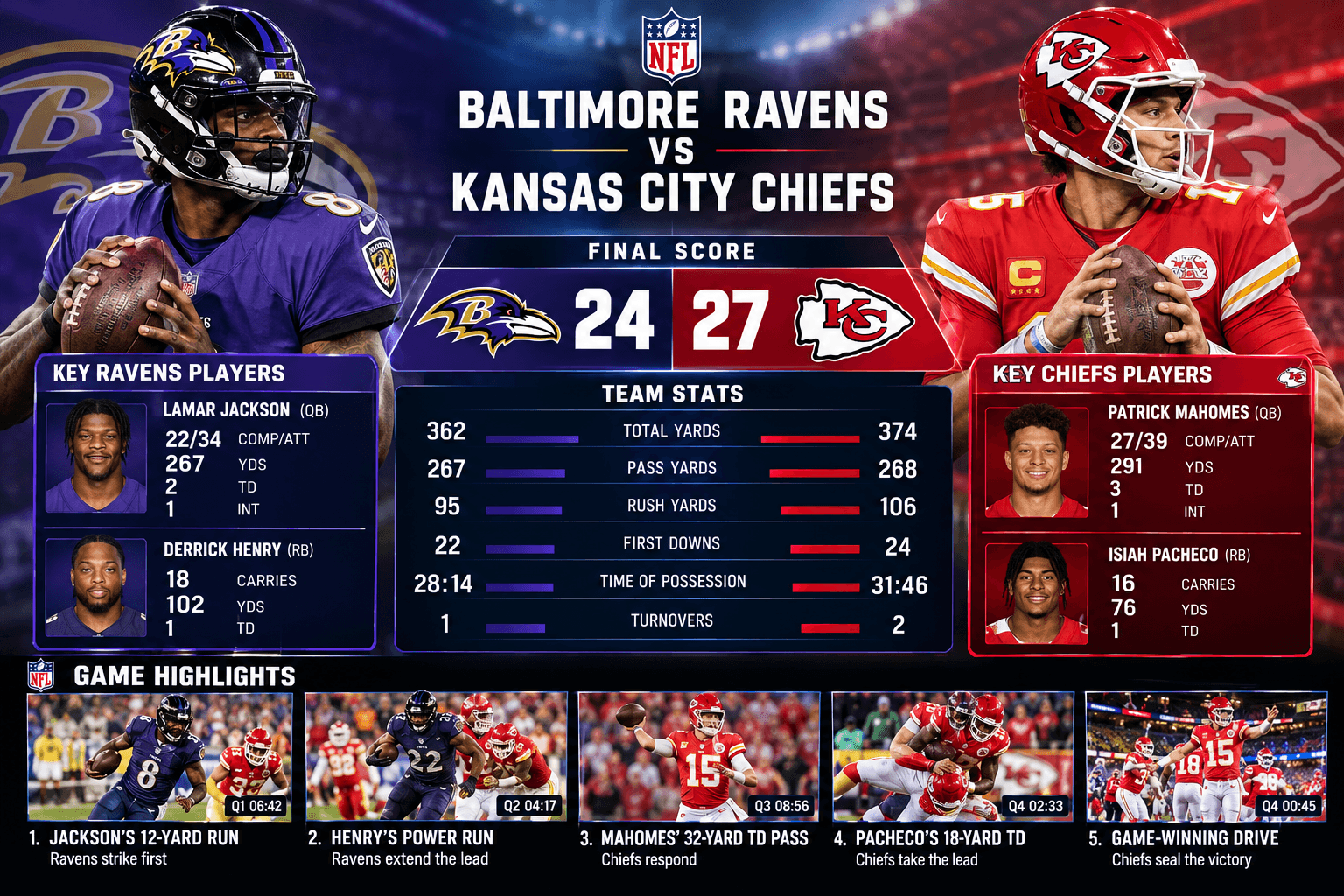
Baltimore Ravens vs Kansas City Chiefs Match Player Stats
The Baltimore Ravens vs Kansas City Chiefs match player stats from September 28, 2025, tell the story of a game in which Kansas City combined efficient quarterback play, explosive receiving, and better control of possession to earn a convincing 37–20 victory.
Patrick Mahomes delivered of the game's defining performances, throwing four touchdown passes without an interception. Baltimore's Lamar Jackson showed his familiar ability to create plays through the air and on the ground, but the Ravens struggled to maintain offensive consistency.
The game was more competitive in individual moments than the final 17-point margin might suggest. Baltimore produced 360 total net yards, and Justice Hill contributed two touchdowns. However, Kansas City's ability to turn opportunities into points ultimately separated the teams.
For fans looking beyond the final score, the passing numbers, rushing performances, receiving production, and team statistics explain why the Chiefs came out on top.
Baltimore Ravens vs Kansas City Chiefs Match Summary
The AFC matchup took place at GEHA Field at Arrowhead Stadium in Kansas City during Week 4 of the 2025 NFL regular season.
| Match Details | Information |
|---|---|
| Match | Baltimore Ravens vs Kansas City Chiefs |
| Date | September 28, 2025 |
| Competition | NFL Regular Season |
| Week | Week 4 |
| Venue | GEHA Field at Arrowhead Stadium |
| Final Score | Kansas City Chiefs 37, Baltimore Ravens 20 |
| Winning Team | Kansas City Chiefs |
| Leading Passer | Patrick Mahomes — 270 yards |
| Leading Rusher | Justice Hill — 76 yards |
| Leading Receiver | Xavier Worthy — 83 yards |
Kansas City finished with 382 total net yards, compared with Baltimore's 360. The difference in yardage was relatively small, but the Chiefs made their offensive possessions count more effectively.
Mahomes completed 25 of 37 passes for 270 yards and four touchdowns. Baltimore's passing game was split between Lamar Jackson and Cooper Rush, who combined for 199 passing yards.
The Chiefs also controlled the ball for more than nine additional minutes, helping them manage the game's pace.
Final Score and Quarter-by-Quarter Breakdown
| Quarter | Baltimore Ravens | Kansas City Chiefs |
|---|---|---|
| First Quarter | 7 | 3 |
| Second Quarter | 3 | 17 |
| Third Quarter | 3 | 10 |
| Fourth Quarter | 7 | 7 |
| Final | 20 | 37 |
Baltimore began the game strongly enough to take a 7–3 lead after the first quarter. That early advantage suggested the Ravens might be able to control the matchup.
The second quarter changed everything.
Kansas City scored 17 points while allowing Baltimore three. By halftime, the Chiefs had turned a four-point deficit into a 20–10 lead.
The Chiefs added another 10 points in the third quarter, creating a 30–13 advantage heading into the final period.
Both teams scored seven points in the fourth quarter, leaving Kansas City with a comfortable victory.
The second and third quarters were particularly important because the Chiefs outscored Baltimore 27–6 during that stretch.
Baltimore Ravens vs Kansas City Chiefs Passing Stats
The quarterback comparison provides of the clearest explanations for the result.
| Player | Team | Completions/Attempts | Passing Yards | TD | INT |
|---|---|---|---|---|---|
| Patrick Mahomes | Chiefs | 25/37 | 270 | 4 | 0 |
| Lamar Jackson | Ravens | 14/20 | 147 | 1 | 1 |
| Cooper Rush | Ravens | 9/13 | 52 | 0 | 0 |
Patrick Mahomes: Four Touchdowns and No Interceptions
Patrick Mahomes was the standout quarterback.
His 270 passing yards were impressive, but the most significant number was his four touchdown passes.
Mahomes completed approximately 67.6% of his attempts while avoiding interceptions. His performance allowed Kansas City to maintain offensive pressure without relying exclusively on the running game.
He distributed touchdown passes to multiple receivers, demonstrating the variety available in Kansas City's passing attack.
Hollywood Brown, JuJu Smith-Schuster, Isiah Pacheco, and Tyquan Thornton each caught a touchdown pass.
That distribution mattered because Baltimore could not focus its coverage on just scoring target.
Mahomes also showed patience in moving the ball, using shorter completions alongside deeper opportunities.
Lamar Jackson: A Difficult Afternoon
Lamar Jackson completed 14 of 20 passes for 147 yards, touchdown, and interception.
His completion percentage was 70%, slightly higher than Mahomes' figure, but his overall passing production was considerably lower.
Jackson also rushed for 48 yards on six carries, showing why he remains dangerous when plays break down.
However, Baltimore's passing attack struggled to generate enough scoring opportunities to keep pace with Kansas City.
Jackson's afternoon was also affected by the game's physical demands, and Cooper Rush entered to handle additional quarterback duties.
Cooper Rush's Contribution
Cooper Rush completed nine of 13 passes for 52 yards.
He did not throw a touchdown or interception.
His appearance gave Baltimore another option at quarterback, but the Ravens could not produce the sustained scoring run necessary to close the gap.
Together, Baltimore's quarterbacks completed 23 of 33 attempts, but Kansas City gained a significant advantage in passing touchdowns.
Rushing Stats: Justice Hill Leads the Ground Game
Baltimore's rushing production featured the game's leading individual rusher, even though the Ravens lost.
| Player | Team | Carries | Rushing Yards | Rushing TD |
|---|---|---|---|---|
| Justice Hill | Ravens | 3 | 76 | 1 |
| Lamar Jackson | Ravens | 6 | 48 | 0 |
| Derrick Henry | Ravens | 8 | 42 | 0 |
| Xavier Worthy | Chiefs | 2 | 38 | 0 |
| Isiah Pacheco | Chiefs | 7 | 35 | 0 |
| Kareem Hunt | Chiefs | 13 | 34 | 0 |
| Patrick Mahomes | Chiefs | 4 | 5 | 0 |
Justice Hill's Explosive Performance
Justice Hill was Baltimore's most productive rusher, gaining 76 yards on three carries.
His biggest contribution was a 71-yard touchdown run, of the most memorable offensive plays of the game.
That single run accounted for most of his rushing yardage and highlighted Baltimore's ability to create explosive plays even during a difficult afternoon.
Hill averaged approximately 25.3 yards per carry, although that figure came from a very small number of attempts.
He also contributed as a receiver, making him of Baltimore's most effective offensive players.
Derrick Henry's Limited Impact
Derrick Henry finished with 42 yards on eight carries.
That represented an average of 5.25 yards per attempt, but Baltimore did not establish the kind of sustained rushing attack that could consistently control the game.
As Kansas City's lead grew, the Ravens faced greater pressure to generate points quickly.
Henry remained a threat on the ground, but his individual production was not enough to change the result.
Kansas City's Rushing Approach
The Chiefs did not depend on a single dominant running back.
Isiah Pacheco gained 35 yards, while Kareem Hunt added 34 yards.
Xavier Worthy contributed 38 yards on two rushing attempts, adding another dimension to the offense.
Kansas City's rushing statistics were less spectacular than some of Baltimore's individual numbers, but the Chiefs were able to combine their ground game with a much more productive passing attack.
Receiving Stats: Xavier Worthy and Zay Flowers Stand Out
Both teams had several receivers involved, but Kansas City generated more scoring production through the passing game.
Kansas City Chiefs Receiving Stats
| Player | Receptions | Receiving Yards | TD |
|---|---|---|---|
| Xavier Worthy | 5 | 83 | 0 |
| Travis Kelce | 5 | 48 | 0 |
| Hollywood Brown | 3 | 38 | 1 |
| JuJu Smith-Schuster | 4 | 36 | 1 |
| Brashard Smith | 3 | 27 | 0 |
| Isiah Pacheco | 2 | 13 | 1 |
| Kareem Hunt | 1 | 13 | 0 |
| Tyquan Thornton | 1 | 11 | 1 |
| Noah Gray | 1 | 1 | 0 |
Xavier Worthy led the Chiefs with 83 receiving yards on five catches.
His ability to create significant gains helped Kansas City stretch the field and keep Baltimore's defense under pressure.
Travis Kelce contributed five receptions for 48 yards. Although he did not score, his involvement provided Mahomes with a reliable receiving option.
The touchdown distribution was especially noteworthy.
Four different Chiefs players caught touchdown passes, making Kansas City's passing attack difficult to contain.
Baltimore Ravens Receiving Stats
| Player | Receptions | Receiving Yards | TD |
|---|---|---|---|
| Zay Flowers | 7 | 74 | 0 |
| Justice Hill | 5 | 41 | 1 |
| Mark Andrews | 7 | 30 | 0 |
| Rashod Bateman | 1 | 24 | 0 |
| Derrick Henry | 2 | 16 | 0 |
| Tylan Wallace | 1 | 14 | 0 |
Zay Flowers led Baltimore with 74 receiving yards on seven catches.
He was the team's most productive receiving option in terms of yardage and remained an important part of the passing attack.
Mark Andrews also caught seven passes, but those receptions produced 30 yards.
That difference illustrates of Baltimore's offensive problems: completing passes did not always translate into substantial gains.
Justice Hill added five receptions for 41 yards and a touchdown, complementing his explosive rushing performance.
His combined rushing and receiving output reached 117 yards, with two total touchdowns.
Hill's versatility was a major positive for Baltimore despite the loss.
Patrick Mahomes vs Lamar Jackson: Who Played Better?
Comparing the two quarterbacks is particularly interesting because they bring different strengths to the field.
Mahomes is known for extending plays, reading defenses, and creating passing opportunities from difficult situations.
Jackson offers a combination of passing ability, mobility, and rushing production that can force defenses to change their approach.
In this particular matchup, Mahomes had the stronger overall performance.
| Statistic | Patrick Mahomes | Lamar Jackson |
|---|---|---|
| Passing Yards | 270 | 147 |
| Passing Touchdowns | 4 | 1 |
| Interceptions | 0 | 1 |
| Completion Percentage | 67.6% | 70.0% |
| Rushing Yards | 5 | 48 |
| Passer Rating | 124.8 | 86.9 |
Jackson contributed more rushing yards and completed a slightly higher percentage of his passes.
However, Mahomes produced 123 more passing yards, threw three additional touchdowns, and avoided turnovers through the air.
Those differences were decisive.
The comparison also demonstrates why completion percentage alone cannot determine which quarterback had the better game.
Mahomes' passing production resulted in significantly more points, while Jackson's individual efficiency was not enough to overcome Baltimore's wider offensive difficulties.
Team Statistics: Where Kansas City Gained the Advantage
The overall team numbers reveal that the game was not simply a case of offense gaining vastly more yards than the other.
| Team Statistic | Baltimore Ravens | Kansas City Chiefs |
|---|---|---|
| Total Net Yards | 360 | 382 |
| Points Scored | 20 | 37 |
| Penalties | 6 | 5 |
| Penalty Yards | 56 | 40 |
| Time of Possession | 25:15 | 34:45 |
Kansas City gained 22 more total net yards than Baltimore.
However, the Chiefs scored 17 more points.
That contrast is of the most revealing statistics from the matchup.
Kansas City made better use of its offensive opportunities, particularly through touchdown passes.
The Chiefs also held possession for 34 minutes and 45 seconds, compared with Baltimore's 25 minutes and 15 seconds.
That nine-and-a-half-minute advantage helped Kansas City control the rhythm of the contest.
Baltimore also committed slightly more penalties and lost more yardage through those infractions.
Although penalties were not the reason for the result, they added to the Ravens' difficulties.
Three Turning Points That Decided the Match
1. Kansas City's Second-Quarter Response
Baltimore led after the first quarter, but Kansas City's 17-point second quarter changed the direction of the game.
The Chiefs entered halftime with a 10-point lead and the momentum firmly in their favor.
That period forced Baltimore to chase the game rather than dictate its preferred tempo.
2. Mahomes' Touchdown Efficiency
Mahomes threw four touchdown passes without an interception.
Kansas City's ability to score through different receivers prevented Baltimore from settling into a consistent defensive approach.
The Chiefs did not need an extraordinary rushing performance because their passing game was producing the necessary points.
3. The Third-Quarter Separation
Kansas City outscored Baltimore 10–3 in the third quarter.
That extended the Chiefs' lead to 17 points before the fourth quarter began.
Baltimore still produced a late touchdown, but the Ravens were unable to create the series of defensive stops and offensive scores required for a comeback.
What the Match Revealed About Both Teams
For Kansas City, the victory highlighted the importance of offensive balance and quarterback efficiency.
Mahomes did not need to throw for 400 yards to dominate the game. His ability to generate touchdowns, avoid interceptions, and involve several receivers was more valuable than a massive passing-yardage total.
Xavier Worthy's production also demonstrated the benefit of having a receiving threat capable of creating explosive gains.
Meanwhile, the Chiefs' time-of-possession advantage showed how sustained drives can reduce opportunities for an opposing offense.
For Baltimore, the game revealed both strengths and weaknesses.
Justice Hill produced two touchdowns and 117 yards from scrimmage. Zay Flowers remained productive, and Jackson contributed with his legs.
Those performances showed that Baltimore had players capable of creating difficult matchups.
However, the Ravens struggled to turn individual highlights into consistent offensive drives.
The gap between occasional explosive plays and sustained scoring efficiency was an important difference between the teams.
Ravens vs Chiefs: Recent Head-to-Head Results
The Ravens and Chiefs have developed a compelling AFC rivalry, with quarterback performances frequently playing an important role.
Here are three notable recent meetings.
| Date | Match | Result |
|---|---|---|
| September 28, 2025 | Ravens at Chiefs | Chiefs won 37–20 |
| September 5, 2024 | Ravens at Chiefs | Chiefs won 27–20 |
| January 28, 2024 | Chiefs at Ravens, AFC Championship | Chiefs won 17–10 |
The September 2024 meeting was much closer than the 2025 contest.
In that game, Lamar Jackson passed for 273 yards and rushed for another 122. Mahomes threw for 291 yards as Kansas City secured a 27–20 victory.
The 2025 matchup followed a different pattern.
Kansas City built a substantial lead through the middle quarters and maintained control, with Mahomes throwing four touchdown passes.
These games demonstrate how the same rivalry can produce different styles of football depending on quarterback execution, defensive performance, and situational opportunities.
Key Player Takeaways
Several individual performances deserve attention beyond the final score.
Patrick Mahomes: His four touchdown passes and zero interceptions made him the most influential player in the game.
Xavier Worthy: His 83 receiving yards and additional rushing production gave Kansas City an explosive offensive option.
Justice Hill: With 76 rushing yards, 41 receiving yards, and two total touchdowns, he delivered Baltimore's standout all-around performance.
Zay Flowers: Seven catches for 74 yards made him Baltimore's leading receiver.
Travis Kelce: Five receptions for 48 yards showed his continued importance as a dependable passing target.
Lamar Jackson: His 48 rushing yards provided an additional offensive dimension, but Baltimore could not match Kansas City's passing-touchdown production.
These numbers show that both teams had productive individuals, but Kansas City delivered the stronger collective performance.
Frequently Asked Questions
Who won the Baltimore Ravens vs Kansas City Chiefs match?
The Kansas City Chiefs defeated the Baltimore Ravens 37–20 on September 28, 2025, in Week 4 of the NFL regular season.
What were Patrick Mahomes' stats against the Ravens?
Patrick Mahomes completed 25 of 37 passes for 270 yards, four touchdowns, and zero interceptions.
How many passing yards did Lamar Jackson have?
Lamar Jackson threw for 147 yards, completing 14 of 20 passes with touchdown and interception. He also rushed for 48 yards.
Who had the most rushing yards in the match?
Justice Hill led both teams with 76 rushing yards on three carries, including a 71-yard touchdown run.
Who was the leading receiver for Kansas City?
Xavier Worthy led the Chiefs with 83 receiving yards on five catches.
Who was Baltimore's leading receiver?
Zay Flowers led Baltimore with seven receptions for 74 yards.
How many touchdowns did Patrick Mahomes throw?
Mahomes threw four touchdown passes against Baltimore, connecting with four different players for scores.
How many total yards did the Chiefs gain?
Kansas City finished with 382 total net yards, compared with Baltimore's 360.
What was the biggest difference between the Ravens and Chiefs?
The Chiefs were more effective at converting offensive opportunities into touchdowns. They also controlled possession longer and received a four-touchdown performance from Mahomes.
Final Thoughts
The Baltimore Ravens vs Kansas City Chiefs match player stats reveal why Kansas City earned a 37–20 victory despite the teams finishing relatively close in total yardage.
Patrick Mahomes was the central figure, throwing four touchdowns without an interception and spreading the ball among several receiving targets.
Baltimore had impressive individual contributions from Justice Hill, Zay Flowers, and Lamar Jackson, but the Ravens could not maintain the scoring consistency required to challenge the Chiefs over four quarters.
Kansas City's ability to control possession, protect the football through its passing attack, and capitalize on scoring opportunities ultimately determined the outcome.
For fans analyzing this matchup, the most important lesson is that total yards do not always tell the full story. Touchdown efficiency, quarterback decisions, and the ability to sustain productive possessions can matter considerably more.
The September 28, 2025, meeting was a clear example of that difference.
Statistical reference: Match figures are based on the Baltimore Ravens' official game statistics and historical NFL box-score records.