
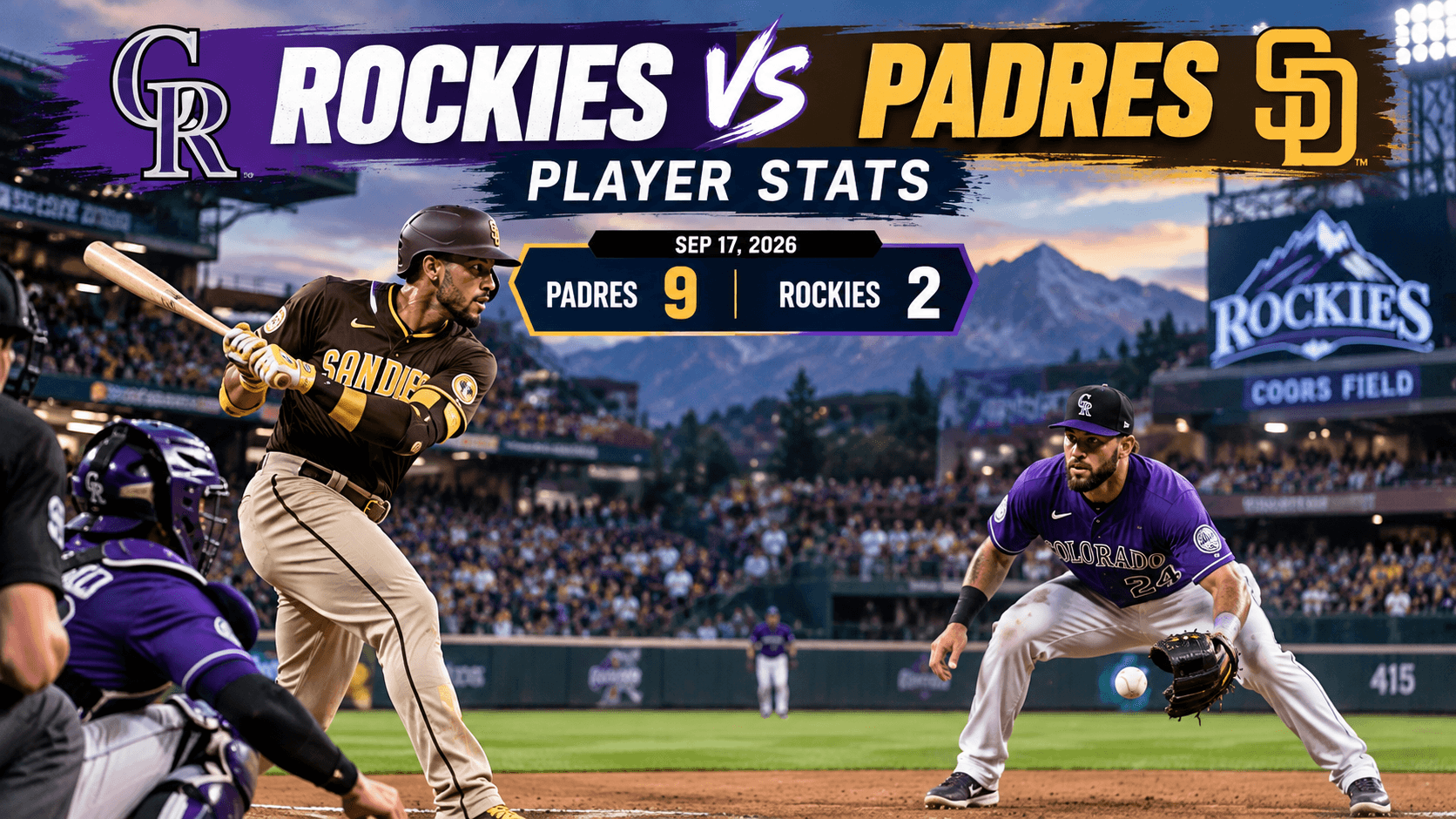
Colorado Rockies vs Padres Match Player Stats: 2026
The Colorado Rockies vs Padres match player stats from September 17, 2026, tell the story of a game in which San Diego's offense delivered consistent production while its pitching staff prevented Colorado from mounting a serious comeback. The Padres defeated the Rockies 9–2 at Coors Field, collecting 15 hits and receiving contributions from several players throughout their batting order.
The final score might suggest a straightforward victory, but the individual performances reveal why San Diego controlled the game.
Dustin Harris drove in three runs, Xander Bogaerts collected three hits and two RBIs, and Jackson Merrill added another two runs batted in. Ty France also recorded three hits, helping the Padres maintain pressure on Colorado's pitching staff.
On the mound, Robbie Ray provided six innings of work, allowing three runs while striking out six batters. The Rockies' bullpen was unable to reverse the damage after starter Mason Adams struggled through the early innings.
For Colorado, Connor Norby and Kyle Karros contributed to the scoring, but the Rockies managed four hits against San Diego's starting pitcher.
The result demonstrated how effective pitching and a balanced lineup can turn an ordinary regular-season matchup into a convincing victory.
Colorado Rockies vs San Diego Padres Match Overview
The September 17 meeting took place during the closing weeks of the 2026 MLB regular season.
San Diego entered the game looking to build on its recent offensive performances, while Colorado hoped to make better use of its home-field advantage.
| Match Details | Information |
|---|---|
| Match | San Diego Padres vs Colorado Rockies |
| Date | September 17, 2026 |
| Competition | MLB Regular Season |
| Stadium | Coors Field, Denver |
| Final Score | Padres 9, Rockies 2 |
| Winning Team | San Diego Padres |
| Padres Hits | 15 |
| Rockies Hits | 9 |
| Winning Pitcher | Robbie Ray |
| Losing Pitcher | Mason Adams |
| Leading RBI Player | Dustin Harris — 3 RBI |
San Diego's offensive depth was particularly important.
Rather than relying on a single player to carry the lineup, the Padres generated hits from multiple positions and created repeated scoring opportunities.
Colorado recorded nine hits, but its offense struggled to convert those opportunities into runs.
The Rockies also failed to keep San Diego from extending its lead during the middle innings.
Rockies vs Padres Final Score by Inning
| Inning | Padres | Rockies |
|---|---|---|
| 1st | 2 | 0 |
| 2nd | 1 | 0 |
| 3rd | 0 | 0 |
| 4th | 1 | 0 |
| 5th | 4 | 0 |
| 6th | 1 | 2 |
| 7th | 0 | 0 |
| 8th | 0 | 0 |
| 9th | 0 | 0 |
| Final | 9 | 2 |
San Diego started quickly, scoring two runs in the first inning and another in the second.
The Padres added a run in the fourth before producing their biggest offensive burst in the fifth.
Four runs in that inning increased the lead to 8–0 and placed Colorado under significant pressure.
San Diego added another run in the sixth, extending its total to nine.
The Rockies finally answered with two runs in the bottom of the sixth, but they could not continue that momentum through the final three innings.
San Diego's relievers kept Colorado scoreless for the remainder of the contest.
San Diego Padres Batting Stats
The Padres finished with 15 hits, nine runs, and nine RBIs.
Their lineup combined timely hitting with contributions from players throughout the batting order.
| Player | AB | Runs | Hits | RBI |
|---|---|---|---|---|
| Fernando Tatis Jr. | 4 | 1 | 1 | 0 |
| Dustin Harris | 5 | 1 | 3 | 3 |
| Manny Machado | 3 | 0 | 0 | 1 |
| Ty France | 4 | 1 | 3 | 0 |
| Jackson Merrill | 4 | 1 | 1 | 2 |
| Xander Bogaerts | 5 | 1 | 3 | 2 |
| Luis Campusano | 4 | 0 | 0 | 0 |
| Jake Cronenworth | 5 | 2 | 2 | 0 |
| Samad Taylor | 4 | 2 | 2 | 1 |
| Team Total | 40 | 9 | 15 | 9 |
The table lists the Padres' principal batting contributors. Pinch hitters and late defensive substitutions are omitted from this condensed view.
Dustin Harris Leads the Padres With Three RBIs
Dustin Harris delivered of San Diego's most valuable offensive performances.
He collected three hits in five at-bats and drove in three runs.
His production helped the Padres build and maintain their lead, particularly during the innings when Colorado's pitching staff struggled to prevent consecutive hits.
Harris' performance was important because driving in runs requires more than simply reaching base.
He capitalized on opportunities created by his teammates and converted them into scoreboard production.
With three RBIs, Harris led both teams in that category.
Xander Bogaerts Delivers Three Hits
Xander Bogaerts also enjoyed a productive afternoon.
He finished with three hits in five at-bats and contributed two RBIs.
His performance provided another reliable source of offense for San Diego.
Bogaerts' three-hit game was especially valuable because it meant Colorado could not focus exclusively on stopping the Padres' most recognizable power hitters.
San Diego's ability to generate hits throughout the lineup made it difficult for the Rockies to escape innings without allowing runs.
Ty France Adds Three Hits
Ty France recorded three hits in four at-bats.
Although he did not drive in a run, his ability to reach base contributed to the Padres' offensive rhythm.
A player does not always need to hit a home run or lead the RBI column to influence a game.
Consistent contact hitting creates opportunities for teammates and forces opposing pitchers to work through longer innings.
France's performance illustrated that point.
Jackson Merrill Drives in Two Runs
Jackson Merrill finished with hit and two RBIs.
His contributions helped San Diego turn scoring opportunities into additional runs.
Merrill's role was especially important because the Padres were receiving production from several different players rather than depending on dominant hitter.
His two RBIs were part of the collective effort that gave San Diego a comfortable lead.
Colorado Rockies Batting Stats
Colorado collected nine hits but scored twice.
The Rockies had opportunities to produce more offense, yet they struggled to string together enough productive at-bats.
| Player | AB | Runs | Hits | RBI |
|---|---|---|---|---|
| Jake McCarthy | 3 | 1 | 1 | 0 |
| Connor Norby | 4 | 0 | 1 | 1 |
| Cole Carrigg | 4 | 1 | 1 | 0 |
| TJ Rumfield | 2 | 0 | 1 | 0 |
| Kyle Karros | 4 | 0 | 1 | 1 |
| Mickey Moniak | 3 | 0 | 2 | 0 |
| Tim Johnston | 4 | 0 | 0 | 0 |
| Brett Sullivan | 4 | 0 | 2 | 0 |
| Zac Veen | 4 | 0 | 0 | 0 |
| Team Total | 33 | 2 | 9 | 2 |
Colorado also used substitutions during the game; the table focuses on the principal batting lines.
Connor Norby's RBI Contribution
Connor Norby finished with hit and RBI.
His contribution helped Colorado avoid a shutout, but the Rockies needed more sustained production from their lineup.
Norby's RBI was of two recorded by the team.
That limited run production was the central problem for Colorado throughout the afternoon.
Kyle Karros Drives in a Run
Kyle Karros also recorded an RBI.
He collected hit in four at-bats and contributed to Colorado's sixth-inning scoring.
However, his individual production was not enough to overcome the deficit San Diego had already established.
Karros' performance was a reminder that even when a team produces timely individual hits, the surrounding offensive opportunities determine how much those contributions affect the game.
Mickey Moniak Records Two Hits
Mickey Moniak was of Colorado's more productive hitters.
He finished with two hits in three at-bats and drew a walk.
His ability to reach base provided opportunities for the Rockies, but those opportunities did not translate into enough runs.
Moniak's performance stood out in a lineup that struggled to generate sustained offensive pressure.
Padres vs Rockies Pitching Stats
Pitching played a major role in the outcome.
San Diego received a strong start from Robbie Ray, while Colorado's starter struggled to contain the Padres' offense.
San Diego Padres Pitching
| Pitcher | IP | Hits Allowed | Earned Runs | Walks | Strikeouts |
|---|---|---|---|---|---|
| Robbie Ray | 6.0 | 3 | 3 | 2 | 6 |
| Adam Morgan | 2.0 | 1 | 0 | 0 | 2 |
| Yuki Matsui | 1.0 | 0 | 0 | 2 | 1 |
Robbie Ray's Winning Performance
Robbie Ray earned the victory after pitching six innings.
He allowed three hits, three earned runs, and two walks while recording six strikeouts.
His performance gave San Diego enough stability to build a substantial offensive advantage.
Ray limited Colorado's ability to generate consistent contact during the early innings.
Although the Rockies produced their scoring in the sixth, the Padres had already established a large lead.
Ray finished the outing with his 13th win of the season.
Adam Morgan and Yuki Matsui Finish the Game
Adam Morgan pitched two scoreless innings, allowing hit and striking out two batters.
Yuki Matsui handled the final inning without allowing a hit.
Together, the relievers prevented Colorado from producing a late comeback.
Their performances were important because the Padres did not need to use additional offensive opportunities to protect the lead.
The bullpen maintained control through the final innings.
Colorado Rockies Pitching Stats
Colorado's pitching staff faced a difficult afternoon against San Diego's productive lineup.
| Pitcher | IP | Hits Allowed | Earned Runs | Walks | Strikeouts |
|---|---|---|---|---|---|
| Mason Adams | 4.1 | 8 | 6 | 3 | 1 |
| Bobby Frasso | 1.2 | 4 | 3 | 0 | 3 |
| Jimmy Herget | 2.0 | 1 | 0 | 0 | 0 |
| Juan Mejia | 1.0 | 0 | 0 | 0 | 3 |
Mason Adams Struggles Against San Diego
Mason Adams started for Colorado but lasted 4⅓ innings.
He allowed eight hits and six earned runs while walking three batters.
Adams recorded strikeout.
Those numbers demonstrate how frequently San Diego made productive contact against him.
By the time Adams left the game, the Padres had established a strong offensive position.
He was charged with the loss.
Bobby Frasso Cannot Stop the Scoring
Bobby Frasso entered in relief and pitched 1⅔ innings.
He allowed four hits and three earned runs.
Although he recorded three strikeouts, San Diego continued adding to its lead.
The combination of Adams' difficult start and Frasso's struggles gave Colorado little opportunity to recover.
Jimmy Herget and Juan Mejia Stabilize the Bullpen
Jimmy Herget pitched two scoreless innings, allowing hit.
Juan Mejia followed with a scoreless inning and three strikeouts.
Their performances were positive for Colorado, but the damage had already been done.
By the time the Rockies' bullpen began consistently retiring hitters, San Diego had built a seven-run lead.
Team Statistics: Padres vs Rockies Comparison
The overall numbers help explain the difference between the teams.
| Statistic | San Diego Padres | Colorado Rockies |
|---|---|---|
| Runs | 9 | 2 |
| Hits | 15 | 9 |
| Errors | 0 | 0 |
| At-Bats | 40 | 33 |
| RBIs | 9 | 2 |
| Walks | 3 | 4 |
| Strikeouts | 9 | 9 |
| Home Runs | 2 | 1 |
The Padres recorded six more hits and seven more runs than Colorado.
Both teams finished without a fielding error, so defensive mistakes were not the main reason for the scoreline.
Instead, San Diego's ability to generate extra-base hits and bring runners home made the difference.
The Padres also received production from several hitters, making it difficult for Colorado to identify player to neutralize.
Colorado managed nine hits, but those hits did not produce enough scoring.
The final statistics demonstrate why batting efficiency matters as much as total opportunities.
Three Major Turning Points
1. San Diego's Fast Start
The Padres scored twice in the first inning.
That early production immediately placed pressure on Colorado's starting pitcher.
San Diego added another run in the second inning, establishing a three-run advantage before the Rockies could respond.
2. The Four-Run Fifth Inning
The fifth inning was the most important offensive period of the game.
San Diego scored four runs, extending its lead to 8–0.
This effectively changed the contest from a manageable deficit into a major challenge for Colorado.
The Rockies needed both a substantial offensive response and several scoreless innings from their pitching staff.
Neither happened quickly enough.
3. Colorado's Sixth-Inning Response
Colorado finally scored two runs in the sixth inning.
Kyle Karros contributed a two-run home run, providing the Rockies with their runs of the game.
However, San Diego had already scored nine times.
The Padres' bullpen then prevented Colorado from scoring again.
The sixth inning offered a brief moment of encouragement for the home team but did not significantly change the outcome.
Why the Padres Won
San Diego's victory was built on three major advantages.
Consistent hitting: The Padres recorded 15 hits, with multiple players collecting two or more.
Productive scoring opportunities: San Diego drove in nine runs and received RBI contributions from several hitters.
Reliable pitching: Robbie Ray provided a solid start, and the bullpen prevented a late Colorado comeback.
The Padres also avoided defensive errors.
That combination allowed San Diego to control the game without relying on a single extraordinary performance.
What the Match Revealed About Colorado
Colorado's offensive problems were not entirely about reaching base.
The Rockies collected nine hits and drew four walks, showing that they could create opportunities.
However, they struggled to convert those baserunners into runs.
The team also faced difficulties on the mound.
Mason Adams and Bobby Frasso combined to allow nine earned runs before the later relievers stabilized the game.
By that point, the Rockies needed a major offensive comeback.
Their two-run sixth inning was not enough.
The result highlighted the importance of limiting early scoring and producing timely hits when runners reach base.
Recent Rockies vs Padres Head-to-Head Results
The teams met four times at Coors Field during their September 2026 series.
| Date | Result | Winner |
|---|---|---|
| September 14, 2026 | Padres 8–7 Rockies | San Diego |
| September 15, 2026 | Rockies 9–3 Padres | Colorado |
| September 16, 2026 | Padres 9–3 Rockies | San Diego |
| September 17, 2026 | Padres 9–2 Rockies | San Diego |
San Diego won three of the four games.
Colorado's victory on September 15 showed that the Rockies were capable of producing a strong offensive performance against the Padres.
However, San Diego responded with consecutive victories to finish the series.
The September 17 game was particularly convincing because the Padres combined 15 hits with a pitching performance that limited Colorado to two runs.
Frequently Asked Questions
Who won the Colorado Rockies vs Padres game?
The San Diego Padres defeated the Colorado Rockies 9–2 on September 17, 2026, at Coors Field in Denver.
Who had the most hits for the Padres?
Dustin Harris, Ty France, and Xander Bogaerts each recorded three hits.
Who had the most RBIs?
Dustin Harris led the game with three RBIs.
How many hits did the Padres record?
San Diego finished with 15 hits.
How many hits did the Rockies have?
Colorado recorded nine hits.
Who was the winning pitcher?
Robbie Ray earned the win after pitching six innings and striking out six batters.
Who was the losing pitcher?
Mason Adams was charged with the loss after allowing six earned runs in 4⅓ innings.
How many RBIs did Xander Bogaerts record?
Xander Bogaerts recorded two RBIs and three hits.
Who hit a home run for Colorado?
Kyle Karros hit a two-run home run in the sixth inning.
Where was the Rockies vs Padres game played?
The matchup took place at Coors Field in Denver, Colorado.
Final Thoughts
The Colorado Rockies vs Padres match player stats from September 17, 2026, show how San Diego earned a convincing 9–2 victory through balanced hitting and effective pitching.
Dustin Harris led the Padres with three RBIs, while Xander Bogaerts and Ty France each recorded three hits.
Robbie Ray provided six innings of work, and San Diego's bullpen prevented Colorado from mounting a late comeback.
The Rockies received contributions from Kyle Karros, Connor Norby, and Mickey Moniak, but their offense could not produce enough runs to challenge the visitors.
San Diego's 15-hit performance was the clearest difference between the teams.
The matchup demonstrated that consistent contact, timely run production, and reliable pitching can be more important than depending on standout player.
All statistics in this article refer to the September 17, 2026, MLB regular-season game between the San Diego Padres and Colorado Rockies.