
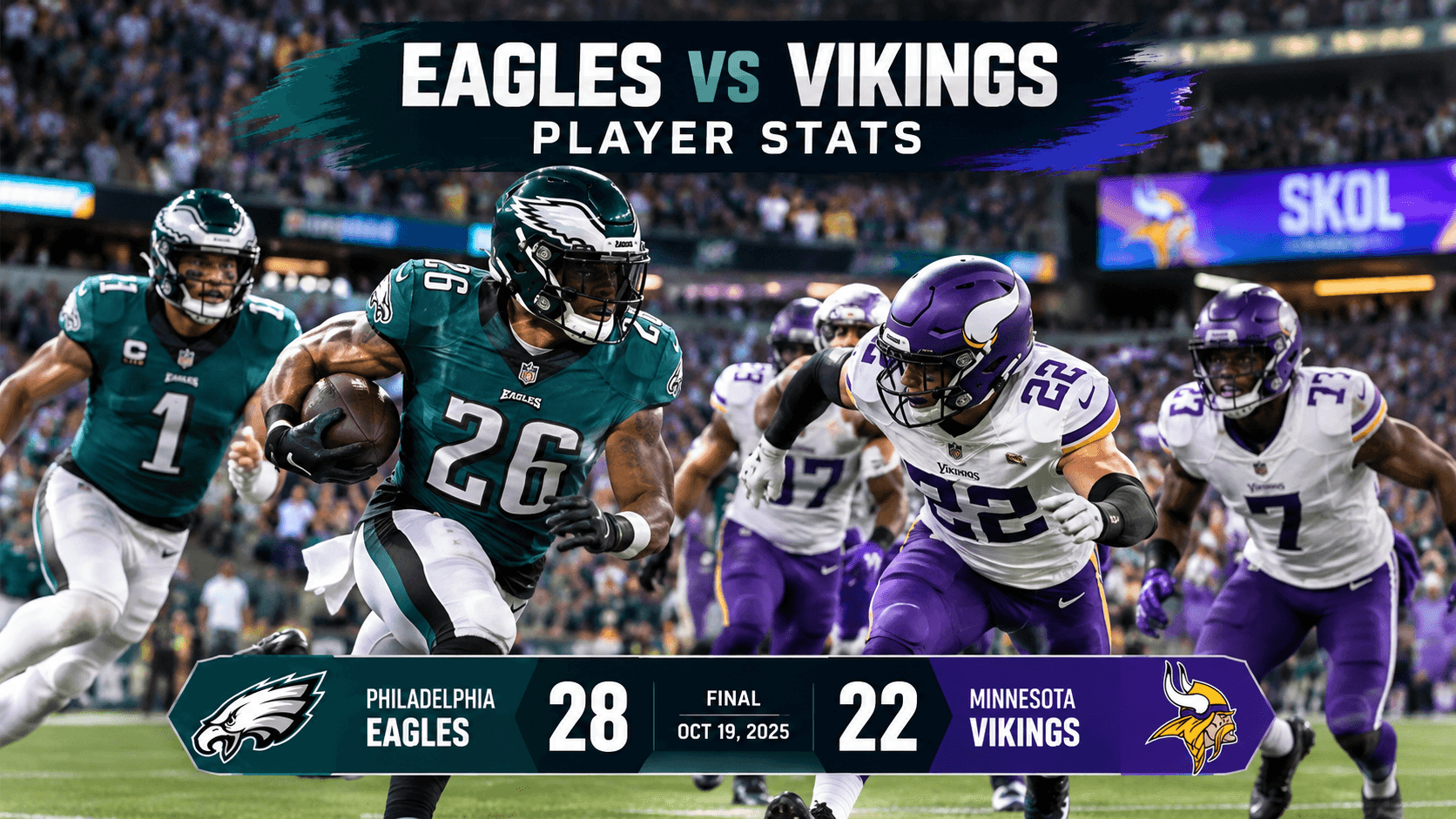
Philadelphia Eagles vs Minnesota Vikings Match Player Stats
The Philadelphia Eagles vs Minnesota Vikings match player stats reveal of the most unusual performances of Week 7 in the 2025 NFL season. Philadelphia defeated Minnesota 28–22 on October 19, 2025, at U.S. Bank Stadium, even though the Vikings gained more total yards, controlled possession longer, and recorded more first downs.
What made the difference? Jalen Hurts delivered an exceptional passing performance, DeVonta Smith dominated downfield, and Philadelphia's defense produced a game-changing interception return touchdown.
Hurts completed 19 of 23 passes for 326 yards and three touchdowns without throwing an interception. His performance earned a perfect 158.3 NFL passer rating. Meanwhile, Minnesota quarterback Carson Wentz threw for 313 yards but was intercepted twice.
The game featured explosive receiving plays, important defensive contributions, and a Minnesota offense that repeatedly moved the football without converting enough opportunities into touchdowns.
For anyone looking beyond the final score, the individual player statistics explain how Philadelphia won despite several statistical advantages belonging to Minnesota.
Philadelphia Eagles vs Minnesota Vikings Match Overview
The Eagles entered the matchup looking to strengthen their position in the NFC, while Minnesota hoped to take advantage of playing at home.
The contest featured an interesting quarterback storyline, with former Eagles quarterback Carson Wentz starting for the Vikings against Philadelphia.
| Match Information | Details |
|---|---|
| Match | Philadelphia Eagles vs Minnesota Vikings |
| Date | October 19, 2025 |
| Competition | NFL Regular Season |
| Week | Week 7 |
| Stadium | U.S. Bank Stadium, Minneapolis |
| Final Score | Eagles 28, Vikings 22 |
| Winning Team | Philadelphia Eagles |
| Leading Passer | Jalen Hurts — 326 yards |
| Leading Receiver | DeVonta Smith — 183 yards |
| Leading Rusher | Jordan Mason — 57 yards |
Philadelphia's offense was particularly effective when throwing the football. Although its rushing attack struggled, the Eagles generated enough explosive plays to maintain their advantage.
Minnesota moved the ball consistently but had difficulty finishing drives.
That contrast shaped the entire afternoon.
Eagles vs Vikings Final Score by Quarter
| Quarter | Eagles | Vikings |
|---|---|---|
| First | 7 | 3 |
| Second | 7 | 3 |
| Third | 7 | 10 |
| Fourth | 7 | 6 |
| Final | 28 | 22 |
Philadelphia scored exactly seven points in each quarter.
Minnesota relied heavily on field goals, scoring offensive touchdown during the game.
The Eagles led 14–6 at halftime, but Minnesota continued to threaten.
The Vikings reduced the deficit to 21–19 early in the fourth quarter before Philadelphia responded with another touchdown pass from Hurts to A.J. Brown.
That score extended the Eagles' lead to 28–19.
Minnesota added a late field goal, but Philadelphia held on for the six-point victory.
Philadelphia Eagles vs Minnesota Vikings Passing Stats
Quarterback performance was of the biggest differences between the teams.
| Quarterback | Team | Completions/Attempts | Yards | TD | INT | Passer Rating |
|---|---|---|---|---|---|---|
| Jalen Hurts | Eagles | 19/23 | 326 | 3 | 0 | 158.3 |
| Carson Wentz | Vikings | 26/42 | 313 | 0 | 2 | 64.9 |
Jalen Hurts: A Perfect Passer Rating
Jalen Hurts delivered a remarkably efficient performance.
He completed 82.6% of his passes and averaged approximately 14.2 yards per attempt.
His 326 passing yards came on 23 attempts, demonstrating Philadelphia's ability to create significant gains without requiring a high volume of passes.
Hurts connected with DeVonta Smith for a 79-yard touchdown and threw two additional touchdown passes to A.J. Brown.
He also avoided interceptions throughout the game.
The result was a perfect 158.3 passer rating, the maximum possible under the NFL's traditional passer-rating formula.
Interestingly, Hurts finished with minus-10 rushing yards on four attempts.
For a quarterback widely recognized for his mobility, this was a game in which his passing ability was clearly the decisive factor.
Carson Wentz: Plenty of Yards, Not Enough Touchdowns
Carson Wentz finished with 313 passing yards, completing 26 of 42 attempts.
He helped Minnesota move the ball and involved several receivers, particularly Jordan Addison and Justin Jefferson.
However, his two interceptions were costly.
One was returned for a touchdown by Philadelphia defender Jalyx Hunt, giving the Eagles seven points without their offense needing to take the field.
Wentz also failed to throw a touchdown pass despite Minnesota accumulating more than 300 gross passing yards.
His 64.9 passer rating reflected the difference between producing yardage and converting that production into scoring success.
Wentz added 28 rushing yards on four attempts, but Philadelphia's defense prevented the Vikings from turning enough of their possessions into touchdowns.
Receiving Stats: DeVonta Smith Steals the Show
Philadelphia's receiving performance was of the most impressive parts of the game.
DeVonta Smith and A.J. Brown combined for 304 receiving yards and three touchdowns.
Their production accounted for almost all of Philadelphia's passing yardage.
Philadelphia Eagles Receiving Stats
| Player | Receptions | Receiving Yards | Touchdowns |
|---|---|---|---|
| DeVonta Smith | 9 | 183 | 1 |
| A.J. Brown | 4 | 121 | 2 |
| Dallas Goedert | 3 | 18 | 0 |
| Will Shipley | 1 | 7 | 0 |
| Tank Bigsby | 1 | -1 | 0 |
| Saquon Barkley | 1 | -2 | 0 |
DeVonta Smith's 183-Yard Performance
DeVonta Smith was the leading receiver on either team.
He caught nine passes for 183 yards, averaging approximately 20.3 yards per reception.
His longest catch was a 79-yard touchdown from Hurts in the third quarter.
That play was especially important because Minnesota had just reduced Philadelphia's lead to five points.
Instead of allowing the Vikings to build momentum, the Eagles immediately restored a larger advantage with explosive pass.
Smith's combination of route running, separation, and downfield production made him of the game's most influential players.
A.J. Brown Scores Twice
A.J. Brown finished with four receptions for 121 yards and two touchdowns.
Although he caught fewer passes than Smith, his catches produced substantial gains.
Brown scored on a 37-yard reception in the first quarter and a 26-yard reception in the fourth.
His second touchdown was particularly valuable because Minnesota had narrowed the deficit to just two points.
Brown's ability to turn limited opportunities into big plays complemented Smith's high-volume production.
Together, they gave Hurts two dangerous receiving options that Minnesota struggled to contain.
Minnesota Vikings Receiving Stats
Minnesota also received strong performances from its wide receivers.
| Player | Receptions | Receiving Yards | Touchdowns |
|---|---|---|---|
| Jordan Addison | 9 | 128 | 0 |
| Justin Jefferson | 5 | 79 | 0 |
| T.J. Hockenson | 6 | 43 | 0 |
| Jalen Nailor | 2 | 37 | 0 |
| Adam Thielen | 1 | 10 | 0 |
| Josh Oliver | 1 | 9 | 0 |
| C.J. Ham | 1 | 5 | 0 |
| Zavier Scott | 1 | 2 | 0 |
Jordan Addison Leads Minnesota
Jordan Addison caught nine passes for 128 yards.
He was Minnesota's leading receiver and provided Wentz with a consistent option throughout the game.
His longest reception went for 34 yards.
Addison's performance demonstrated that the Vikings could generate productive passing plays, even against a Philadelphia defense that made several crucial stops.
However, he did not score a touchdown.
That was a recurring problem for Minnesota's receiving group: productive yardage without corresponding touchdown production.
Justin Jefferson's Contribution
Justin Jefferson caught five passes for 79 yards.
His longest reception gained 40 yards, showing that he remained capable of producing explosive plays.
Jefferson was targeted 10 times, but the Eagles limited his overall impact compared with some of his most dominant performances.
Minnesota also involved tight end T.J. Hockenson, who caught six passes for 43 yards.
The distribution of receptions showed that Wentz had multiple targets available, but Philadelphia defended effectively when the Vikings approached scoring territory.
Rushing Stats: A Difficult Day for Saquon Barkley
Neither team produced a dominant rushing performance.
Minnesota had the better overall rushing numbers, while Philadelphia relied heavily on its passing game.
| Player | Team | Carries | Rushing Yards | TD |
|---|---|---|---|---|
| Jordan Mason | Vikings | 15 | 57 | 1 |
| Saquon Barkley | Eagles | 18 | 44 | 0 |
| Carson Wentz | Vikings | 4 | 28 | 0 |
| Tank Bigsby | Eagles | 1 | 11 | 0 |
| Zavier Scott | Vikings | 4 | 4 | 0 |
| Jalen Hurts | Eagles | 4 | -10 | 0 |
Saquon Barkley Held to 44 Yards
Saquon Barkley carried the ball 18 times for 44 yards.
His average of approximately 2.4 yards per carry showed how effectively Minnesota limited Philadelphia's rushing opportunities.
Barkley's longest run gained nine yards.
For an offense with such a dangerous running back, those numbers might ordinarily create serious problems.
However, Philadelphia compensated with outstanding quarterback play and explosive receiving performances.
The Eagles finished with 45 net rushing yards as a team.
Jordan Mason Scores Minnesota's Touchdown
Jordan Mason led the game with 57 rushing yards on 15 carries.
He scored Minnesota's touchdown on a one-yard run during the third quarter.
The touchdown brought the Vikings within five points, making the game competitive again.
Mason averaged 3.8 yards per carry, providing steady rather than explosive rushing production.
Minnesota finished with 89 net rushing yards, almost double Philadelphia's total.
Despite that advantage, the Vikings could not convert enough scoring opportunities into touchdowns.
Eagles vs Vikings Team Stats Comparison
The team statistics reveal why this game was more complicated than the final score suggests.
| Statistic | Philadelphia Eagles | Minnesota Vikings |
|---|---|---|
| Total Net Yards | 361 | 387 |
| Net Passing Yards | 316 | 298 |
| Rushing Yards | 45 | 89 |
| First Downs | 13 | 21 |
| Third-Down Efficiency | 3/10 | 7/15 |
| Turnovers Lost | 0 | 2 |
| Penalties | 8 | 3 |
| Penalty Yards | 64 | 30 |
| Time of Possession | 25:58 | 34:02 |
| Offensive Touchdowns | 3 | 1 |
| Defensive Touchdowns | 1 | 0 |
Minnesota gained 26 more net yards than Philadelphia.
The Vikings also recorded eight more first downs and controlled the ball for over eight additional minutes.
Their third-down conversion rate was considerably better.
Yet Philadelphia won.
The most important difference was how each team used its opportunities.
The Eagles produced three passing touchdowns and defensive touchdown, while Minnesota managed offensive touchdown.
The Vikings were successful at moving the ball between the 20-yard lines but repeatedly struggled to finish drives.
Philadelphia, by contrast, needed fewer plays to generate major scoring gains.
The Defensive Play That Changed the Game
One of the biggest moments came in the second quarter.
With Philadelphia leading 7–3, Jalyx Hunt intercepted Carson Wentz and returned the ball 42 yards for a touchdown.
The defensive score extended the Eagles' advantage to 14–3.
It also demonstrated the importance of turnovers in a game where the opposing team was otherwise moving the ball effectively.
Minnesota eventually finished with more total yardage and more first downs, but the interception return directly added seven points to Philadelphia's total.
The Vikings could not afford mistakes of that magnitude when their offense was already having difficulty scoring touchdowns.
Hunt's contribution was arguably as important as several of Philadelphia's biggest offensive plays.
Will Reichard's Five Field Goals
Minnesota kicker Will Reichard delivered a productive performance.
He successfully converted all five of his field-goal attempts.
His makes came from 59, 34, 28, 35, and 29 yards.
The 59-yard field goal in the first quarter was particularly impressive.
However, Minnesota's reliance on field goals highlighted its red-zone difficulties.
The Vikings entered Philadelphia's red zone six times but scored touchdown on those opportunities.
That represented a touchdown conversion rate of approximately 16.7%.
Field goals kept Minnesota within reach, but repeatedly settling for three points made it difficult to overcome Philadelphia's more explosive scoring plays.
Four Key Moments That Decided the Game
1. A.J. Brown's Opening Touchdown
Philadelphia took the lead when Hurts connected with Brown for a 37-yard touchdown in the first quarter.
The play established the Eagles' ability to attack Minnesota downfield.
2. Jalyx Hunt's Pick-Six
Hunt's 42-yard interception return touchdown gave Philadelphia a major advantage in the second quarter.
It also punished Minnesota for a costly quarterback mistake.
3. DeVonta Smith's 79-Yard Touchdown
Early in the third quarter, Minnesota had reduced Philadelphia's lead to 14–9.
Hurts responded by connecting with Smith for a 79-yard touchdown.
The Eagles regained control immediately, preventing the Vikings from building on their momentum.
4. Brown's Fourth-Quarter Touchdown
Minnesota closed the gap to 21–19 in the fourth quarter.
Philadelphia answered with a 26-yard touchdown pass from Hurts to Brown.
That score gave the Eagles a nine-point lead and placed additional pressure on Minnesota's offense.
The Vikings managed another field goal, but the Eagles maintained their advantage until the final whistle.
Why Philadelphia Won Despite Fewer Total Yards
Football games are not decided by total yardage alone.
Philadelphia's victory illustrated the importance of explosive plays, turnover avoidance, and scoring efficiency.
The Eagles averaged approximately 7.4 yards per offensive play, compared with Minnesota's 5.8.
That difference meant Philadelphia generated more yardage from each offensive snap, even though the Vikings ran considerably more plays.
Hurts also protected the football, finishing without an interception.
Wentz threw two interceptions, including returned for a touchdown.
Another important factor was Philadelphia's receiving production.
Smith and Brown combined for 304 yards, accounting for more than 93% of Hurts' passing yardage.
Their three receiving touchdowns allowed the Eagles to overcome a rushing attack that produced 45 yards.
Minnesota's offense was capable of moving the chains, but Philadelphia was better at creating the plays that directly influenced the scoreboard.
Jalen Hurts vs Carson Wentz: Quarterback Comparison
The matchup carried additional interest because Wentz previously played for Philadelphia.
Both quarterbacks threw for more than 300 yards, but their performances produced very different results.
Hurts completed 19 passes for 326 yards, while Wentz needed 26 completions to reach 313 yards.
Hurts averaged approximately 14.2 yards per attempt, compared with Wentz's 7.5.
The Eagles quarterback also threw three touchdowns without an interception.
Wentz did not throw a touchdown and was intercepted twice.
The difference was not simply accuracy. Hurts completed passes that consistently produced larger gains and more points.
His perfect passer rating reflected of the strongest individual performances of the afternoon.
What This Game Meant for the Eagles and Vikings
Philadelphia improved to 5–2 with the victory, while Minnesota fell to 3–3.
For the Eagles, the result showed that their passing attack could carry the offense when the running game struggled.
Hurts demonstrated exceptional efficiency, and Philadelphia's two leading wide receivers proved capable of producing explosive touchdowns.
The defense also contributed directly to the scoreboard through Hunt's interception return.
For Minnesota, the game exposed a frustrating problem.
The Vikings moved the ball effectively, won the time-of-possession battle, and produced more first downs.
However, their inability to finish drives with touchdowns prevented them from turning those advantages into a victory.
The performance suggested that yardage production alone would not be enough without improved red-zone execution and ball security.
Frequently Asked Questions
Who won the Philadelphia Eagles vs Minnesota Vikings game?
The Philadelphia Eagles defeated the Minnesota Vikings 28–22 on October 19, 2025, during Week 7 of the NFL regular season.
What were Jalen Hurts' passing stats?
Jalen Hurts completed 19 of 23 passes for 326 yards, three touchdowns, and zero interceptions. He recorded a perfect 158.3 passer rating.
How many passing yards did Carson Wentz have?
Carson Wentz threw for 313 yards, completing 26 of 42 passes. He finished with zero passing touchdowns and two interceptions.
Who had the most receiving yards?
DeVonta Smith led all players with 183 receiving yards on nine receptions, including a 79-yard touchdown.
How many touchdowns did A.J. Brown score?
A.J. Brown caught two touchdown passes and finished with 121 receiving yards on four catches.
How many rushing yards did Saquon Barkley have?
Saquon Barkley rushed for 44 yards on 18 carries and did not score a touchdown.
Who led the Vikings in receiving yards?
Jordan Addison led Minnesota with 128 receiving yards on nine receptions.
Who scored Minnesota's touchdown?
Jordan Mason scored the Vikings' touchdown on a one-yard rushing play in the third quarter.
How many field goals did Will Reichard make?
Will Reichard made all five of his field-goal attempts, including a 59-yard kick.
Where was the Eagles vs Vikings game played?
The game took place at U.S. Bank Stadium in Minneapolis, Minnesota, on October 19, 2025.
Final Thoughts
The Philadelphia Eagles vs Minnesota Vikings match player stats show how a team can win without dominating every statistical category.
Minnesota finished with more total yards, more first downs, and longer possession time, but Philadelphia produced the game's most valuable plays.
Jalen Hurts' 326 passing yards, three touchdowns, and perfect passer rating were central to the victory.
DeVonta Smith added 183 receiving yards, A.J. Brown scored twice, and Jalyx Hunt contributed a crucial defensive touchdown.
For Minnesota, Jordan Addison, Carson Wentz, and Jordan Mason all generated meaningful offensive production. However, turnovers and missed touchdown opportunities ultimately proved costly.
Philadelphia's 28–22 victory was a reminder that efficient quarterback play, explosive scoring, and timely defense often matter more than simply accumulating yards.
Statistics refer specifically to the October 19, 2025, Week 7 game. They should not be confused with other meetings between the Philadelphia Eagles and Minnesota Vikings.