
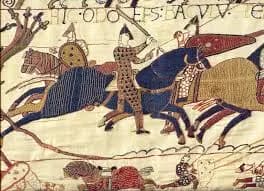
On October 14, 1066, King Harold II of England was defeated by the Norman forces of William, Duke of Normandy, at the Battle of Hastings. Fought on Senlac Hill, roughly seven miles from Hastings, England, the bloody, all-day conflict ended with King Harold’s death and the total destruction of his forces. According to historical legend, Harold was killed by an arrow shot directly through his eye. His demise marked the end of the Anglo-Saxon phase of English history.
The roots of the conflict began years earlier in 1051. William, the Duke of Normandy, is believed to have visited England and met with his cousin, Edward the Confessor, the childless English king. Norman historians argue that during this visit, Edward promised to name William as his rightful heir to the throne.
However, on his deathbed in early 1066, King Edward changed his decree, granting the kingdom instead to Harold Godwine. As the head of England's leading noble family, Godwine was already more powerful than the king himself. Following Edward's death in January 1066, Harold was promptly proclaimed King Harold II. William immediately disputed the claim, setting a massive invasion into motion.
Just over two weeks before the fateful battle, on September 28, 1066, William sailed across the English Channel and landed at Pevensey on Britain’s southeast coast. He brought a formidable invasion force consisting of approximately 7,000 troops and heavy cavalry. After successfully seizing Pevensey, William marched his forces toward Hastings, where they paused to set up camp and organize for the coming clash. King Harold reached the vicinity of Hastings with his army on October 13. The very next morning, William led his Norman troops out the battlefield to give chase.
Following his victory on Senlac Hill, William marched directly on London. Facing little remaining military resistance, he received the official submission of the city. On Christmas Day, 1066, William was crowned the first Norman king of England during a grand ceremony at Westminster Abbey.
The structural shifts triggered by the Norman victory permanently altered the trajectory of European history. French became the official language of the king’s court. Over generations, it gradually blended with the native Anglo-Saxon tongue, ultimately giving birth to modern English. As William I, he proved to be a highly effective administrator. His most notable achievement was commissioning the "Domesday Book," a monumental, comprehensive census of the lands and people of England. Upon the death of William the Conqueror in 1087, his son, William Rufus, succeeded him as William II, securing the second generation of Norman rule over England.