
Fentomagazine com Technology Magazine: What to Know First
Fentomagazine com technology magazine is the kind of search people make when they’ve spotted a name and want to know if it’s worth adding to their reading list. That’s a smart instinct. There are thousands of tech publications now, and the difference between a useful and a time-waster often comes down to a few things you can check in five minutes.
This guide covers what’s publicly known about Fento Magazine, then gives you a scoring system that works for any technology magazine, plus advice on building a reading list that keeps you informed without burning you out.
What’s Publicly Known About Fento Magazine
Public overviews describe FentoMagazine.com as an active digital publication that expanded from an early focus on comments and social-media conversations into a broader range of general-interest subjects. Another overview notes that its content includes business-oriented topics related to technology, marketing, branding, operations and digital communication.
Two details are worth keeping in mind:
- The main site is FentoMagazine.com, and reviewers found no clearly labeled separate U.S. edition.
- Reviewers also said the public pages they checked don’t clearly name a specific founder or owner.
That tells you what kind of site it is, but not how good its technology coverage is. The sections below help you judge that yourself, using the same test you’d apply to any magazine.
Magazine, Blog or Newsletter: Which Is Which?
The word “magazine” gets used loosely online. Knowing the differences helps you set expectations.
| Format | Typical strength | Typical weakness | Best for |
|---|---|---|---|
| Technology magazine | Edited, themed, often longer pieces with a clear editorial voice | Slower than news; quality varies by team | Context and deep dives |
| Tech blog | Personal voice, quick takes, niche expertise | Can be one-person opinions without fact-checking | Hands-on tips and communities |
| Newsletter | Curated, short, delivered to your inbox | Depends heavily on the curator’s taste | Time-poor readers |
| News site | Speed and breadth | Pressure to publish fast can hurt depth | Breaking stories |
| Aggregator | Everything in place | Little original reporting | Discovering sources |
A real magazine usually has an editor, a defined audience, and a consistent standard for what gets published. If a site calls itself a magazine but publishes dozens of near-identical posts a day with no bylines, treat the label with caution.
Anatomy of a Good Technology Magazine
When a technology magazine is working well, you can usually spot these six elements:
- A clear point of view. You can tell who it’s for, such as beginners, developers or business owners.
- Named contributors. Real people with short bios, not an anonymous “admin.”
- Original material. Hands-on tests, interviews, screenshots or data, not just rewritten press releases.
- Context, not just news. It explains why a development matters and who it affects.
- Honest limits. Reviews that say where a product falls short.
- Accountability. Visible dates, corrections and a way to contact the team.
If a magazine has four or more of these, it’s probably worth a trial. Fewer than three should make you cautious.
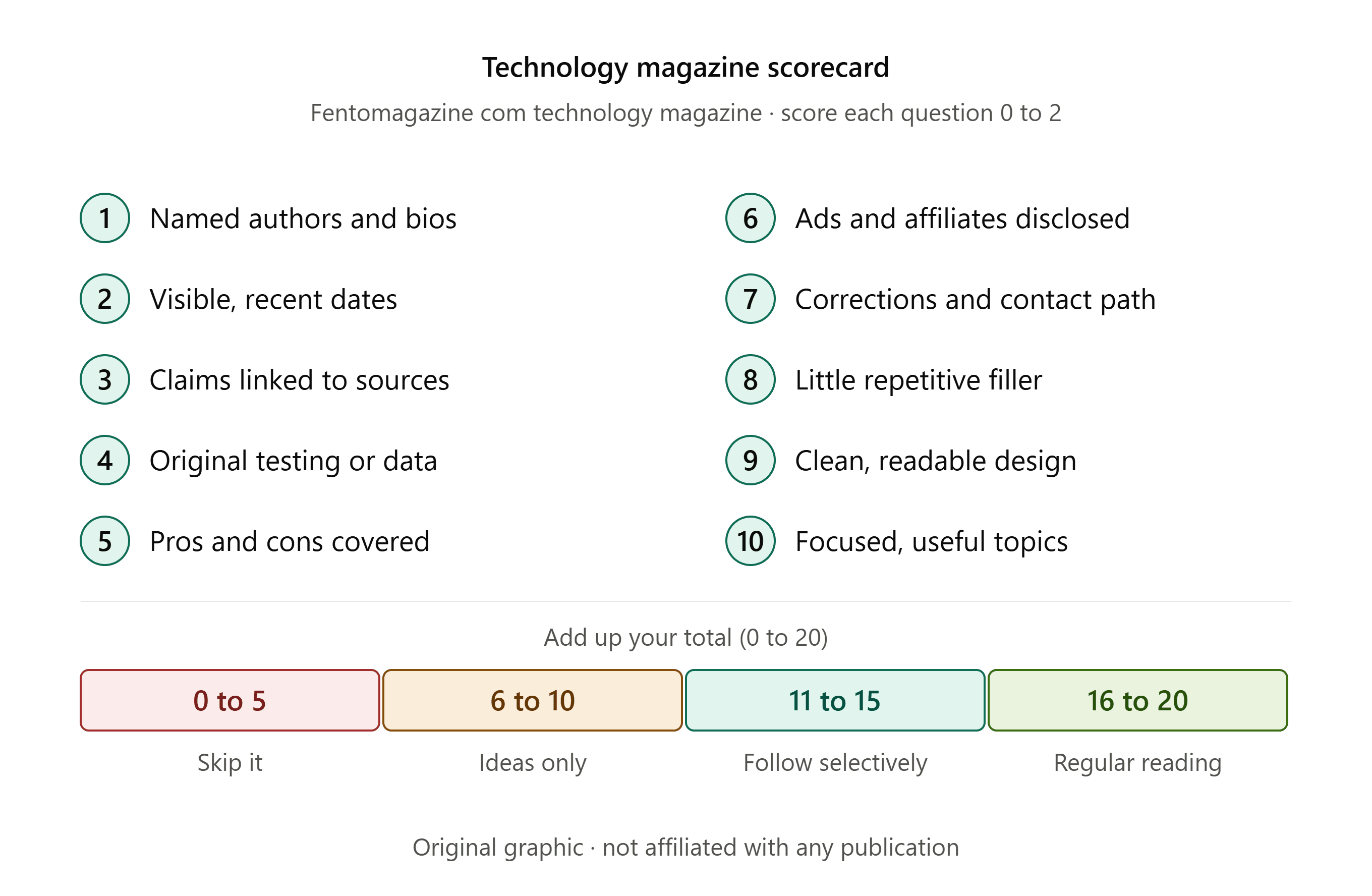
The 10-Point Scorecard
Score any technology magazine from 0 to 2 on each line (0 = absent, 1 = partly, 2 = clearly present). Spend about ten minutes browsing five or six articles before you score.
| # | Question | 0 | 1 | 2 |
|---|---|---|---|---|
| 1 | Are authors named with short bios? | None | Some | Most |
| 2 | Are dates visible and recent? | No dates | Some dates | Clear dates and updates |
| 3 | Are claims linked to sources? | Never | Occasionally | Regularly |
| 4 | Is there original testing, data or reporting? | None | Some | Frequent |
| 5 | Are pros and cons both covered? | Only praise | Sometimes | Consistently |
| 6 | Is advertising/affiliate use disclosed? | Hidden | Vague | Clear |
| 7 | Is there a corrections or contact path? | None | Basic form | Clear policy |
| 8 | Does the site avoid repetitive filler? | Mostly filler | Mixed | Mostly substance |
| 9 | Is the design easy to read? | Cluttered | OK | Clean and fast |
| 10 | Do topics match real reader needs? | Random | Mixed | Focused and useful |
How to read your score:
- 16 to 20: A strong candidate for your regular reading list.
- 11 to 15: Worth following selectively, and verify important claims elsewhere.
- 6 to 10: Use for ideas only, never as a sole source.
- 0 to 5: Skip it.
This works equally well for Fento Magazine, a famous publication or a new site you stumbled on.
How Technology Magazines Make Money (and Why You Should Care)
Understanding the business model helps you read with the right level of trust.
- Subscriptions and memberships tend to align a magazine with its readers, since readers pay for quality.
- Display advertising is common, and it can push sites toward volume and clicks.
- Affiliate links pay a commission when you buy through a link. They aren’t bad on their own, but the best publications say so clearly and still recommend honestly.
- Sponsored content is paid placement. It should be labeled, and you should treat it as marketing.
- Events and newsletters are growing revenue sources for some publishers.
None of these makes a publication untrustworthy by default. What matters is transparency. If you can’t tell how a site earns money, ask yourself why.
Print vs Digital Technology Magazines
| Factor | Digital | |
|---|---|---|
| Speed | Slow, monthly or quarterly | Fast, daily or live |
| Depth | Often longer, polished features | Ranges from quick posts to long reads |
| Distraction | Low | High (links, notifications) |
| Searchability | Hard | Easy |
| Cost | Subscription or newsstand | Free, ad-supported or paid |
| Updates | Fixed printed | Can be corrected and updated |
Many readers use both: digital for staying current, and a print or long-form source for deeper thinking.
Build Your Own Tech Reading Stack
Instead of following everything, build a small, balanced set of sources:
- One fast news source for what happened this week.
- One deep-dive source for long features and analysis.
- One practical source for reviews, how-tos and buying advice.
- One security and privacy source for safety updates.
- One wildcard in a niche you enjoy, such as gaming, space, open-source or gadgets.
Well-known examples across these categories include Wired, MIT Technology Review, IEEE Spectrum and Ars Technica, though what suits you depends on your level and interests. Try each for two weeks, then keep the you actually finish reading.
Reading Habits That Make Any Magazine More Useful
- Read headlines, then decide. Don’t open everything. Pick two or three stories a day.
- Save long reads for a set time. A Saturday coffee beats constant tab-hopping.
- Verify before sharing. Look for a second source on surprising claims.
- Keep a notes file. line per useful idea turns reading into learning.
- Unsubscribe without guilt. If you haven’t opened a newsletter in a month, remove it.
Common Mistakes When Choosing a Technology Magazine
- Judging by design alone. A polished site isn’t always an accurate one.
- Trusting the “most popular” label. Popularity measures attention, not accuracy.
- Following too many sources. More sources usually means more noise.
- Ignoring dates. A great guide from five years ago may be outdated now.
- Never checking who runs it. An About page with real names beats a vague mission statement.
If You’re Building a Technology Magazine Yourself
If your goal is to start or grow a tech site, the same qualities readers look for are the that earn lasting traffic:
- Show real people. Add author pages with experience and photos.
- Test things yourself. Original screenshots and measurements beat rewritten spec sheets.
- Pick a focus. A magazine for small-business owners beats a magazine about everything.
- Update old posts. Add a “last updated” date and fix outdated advice.
- Disclose clearly. Label affiliate and sponsored content.
- Publish less, better. A few strong articles a week beat dozens of thin ones.
Frequently Asked Questions
What is fentomagazine com technology magazine?
It’s a search phrase for FentoMagazine.com’s technology-related content. Public overviews describe the site as a digital publication whose coverage has broadened beyond social media.
Is Fento Magazine a print magazine?
Public descriptions present it as a digital publication, so check the site directly for any print offering.
How do I know whether a tech magazine is trustworthy?
Use the 10-point scorecard above: named authors, visible dates, linked sources, original testing, balance, disclosure and corrections.
Are free technology magazines good enough?
Many are. Free doesn’t mean low quality, but check how the site earns money and whether it discloses it.
How many tech sources should I follow?
Three to five well-chosen sources usually beat a dozen you never finish.
Should I trust sponsored tech articles?
Treat them as advertising. They can still contain useful information, but they aren’t independent reviews.
Final Thoughts
A technology magazine is as useful as its habits: named authors, honest reporting, clear dates, and respect for the reader’s time. Whether you’re curious about fentomagazine com technology magazine or comparing a dozen others, the scorecard gives you a quick, fair way to decide.
Spend ten minutes testing before you commit, keep your reading list small, and treat every source, including this one, with healthy curiosity.
Disclaimer: This article is for general information only. Details about third-party websites come from public overviews and may change, so verify them directly on the site. Always check important claims with official sources.