
Fentomagazine com About Us: What to Know and What to Verify
Fentomagazine com about us is a search people make when they land on an unfamiliar site and want to know who’s behind it. That habit is worth keeping. An About Us page is the closest thing a website has to a handshake, and learning to read carefully can save you from low-quality sources, misleading pages and outright scams.
This guide covers what public overviews say about Fento Magazine’s About page, then teaches you how to read any About page critically. If you run a site yourself, the last sections show how to write that earns trust.
What Public Overviews Say About Fento Magazine
According to third-party overview, Fento Magazine’s About Us page says the publication explores how comments, feedback and digital discussions influence people, culture and society. The same overview notes that the site provides standard pages including About Us, Contact, Privacy Policy, Terms of Service, Disclaimer and a Site map.
Other write-ups add a few details:
- The publication started with an emphasis on social-media comments and has broadened into general-interest subjects.
- Reviewers said the public pages they checked don’t clearly name a specific founder or owner.
- The site’s legal pages reportedly reference New York law.
The overview itself cautions readers to separate verified information from assumptions about ownership. That’s good advice, and it’s the principle for the rest of this article: trust what you can confirm, and treat everything else as unverified.
These descriptions come from outside sources and may be out of date, so open the About page yourself and compare.
Why the About Us Page Matters
Search engines and readers both use About pages to answer three questions:
- Who is responsible for this content?
- Why does this site exist?
- How can I reach them if something is wrong?
Google’s quality guidance for evaluators emphasizes experience, expertise, authoritativeness and trustworthiness, often shortened to E-E-A-T. An About page that names real people, explains the mission and shows how to make contact supports all four. A vague doesn’t hurt on its own, but it removes a chance to build trust.
How to Read an About Page: What They Say vs What to Verify
Marketing language is easy to write. Evidence is harder. Use this table as you read any About Us page, including Fento’s.
| What the page may say | What to verify |
|---|---|
| “We’re a trusted source” | Look for named writers, examples of original work and mentions on independent sites |
| “Our team of experts” | Check whether the experts are named, with bios and credentials you can search |
| “Founded in [year]” | Compare it against archived versions of the site and domain history |
| “Read by millions” | Look for any independent proof; traffic claims are often unverifiable |
| “We cover topic in depth” | Browse recent articles and judge whether they are actually in-depth |
| “Contact us anytime” | Confirm there’s a working email or form, and ideally a physical or business address |
| “We value accuracy” | Look for a corrections policy and visible update dates |
| “Independent publication” | Check how the site makes money and whether sponsorships are disclosed |
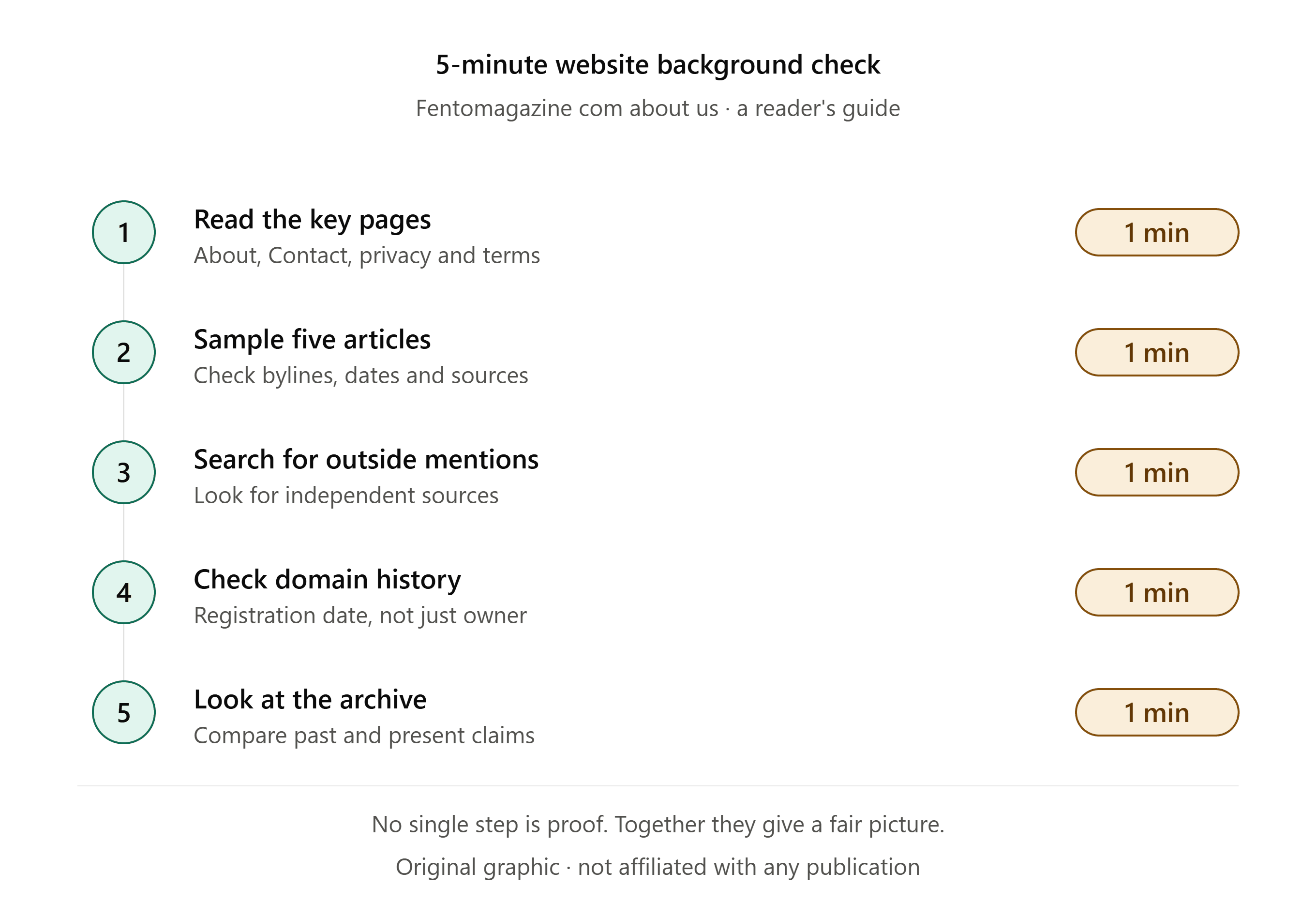
The 5-Minute Background Check
You can learn a lot about a website without special tools. Try these steps in order.
Step 1: Read the About, Contact and policy pages (1 minute).
Look for real names, a working contact method, and clear privacy and terms pages. Their existence doesn’t prove quality, but their absence is a warning sign.
Step 2: Sample five articles (1 minute).
Do they have bylines, dates and sources? Do they read as if a person with real knowledge wrote them, or are they repetitive and generic?
Step 3: Search the site’s name plus words like “review” or “about” (1 minute).
See what independent sources say, and be careful with pages that repeat the site’s own claims. Low-authority blog posts that echo each other aren’t independent confirmation.
Step 4: Check the domain’s history (1 minute).
Public domain lookup tools can show registration dates. Many legitimate sites hide owner details with privacy protection, so a hidden owner isn’t proof of a problem. A very new domain making huge claims is worth a second look.
Step 5: Look at an archived version (1 minute).
The Wayback Machine at archive.org shows how a site looked in the past. If the “about” story has changed dramatically, ask why.
None of these steps is conclusive on its own. Together, they give you a fair picture.
Green Flags and Red Flags on Any About Page
| Green flags | Red flags |
|---|---|
| Named people with photos and short bios | Only “admin” or “the team” with no names |
| Clear mission and audience | Generic text that could describe any site |
| Working contact details | Contact form only, or no contact method |
| Visible editorial or review process | No mention of how content is checked |
| Honest limits (“we don’t give medical advice”) | Big promises (“guaranteed results”) |
| Disclosure of ads and affiliates | Hidden sponsorships |
| Consistent details across pages | Contradictions between pages |
What an Magazine’s About Page Should Tell You
If you’re reading a magazine’s About page, these are the answers you should be able to find:
- Topic focus: What does it cover, and for whom?
- Origin: When and why did it start?
- People: Who edits and writes it?
- Standards: How are facts checked and mistakes corrected?
- Money: How is it funded?
- Contact: How do readers, advertisers and contributors reach the team?
If three or more of these are missing, treat the publication as a casual source and cross-check anything important elsewhere.
If You Run a Website: How to Write a Strong About Page
Many About pages are either empty (“Welcome to our blog!”) or stuffed with keywords. A good is simple, honest and specific. Use this blueprint, and write it in your own words.
1. Start with who it’s for and what it helps them do.
Open with the reader, not with the company.
2. Tell the origin story briefly.
Two or three sentences on why the site started and what gap it fills.
3. Introduce the people.
Add names, roles and a sentence about each person’s experience. Real photos help.
4. Explain how you work.
Describe how you research, test or check facts, and how often you update content.
5. Be open about money.
Say whether you earn from ads, affiliate links, subscriptions or sponsorships.
6. Show how to reach you.
Provide an email address, and a business address if you have one.
7. Link to your policies.
Connect to your privacy policy, terms, disclaimer and corrections page.
8. Keep it current.
Update it when your team or focus changes.
Fill in each bracket with real facts. Placeholder or invented details do more harm than leaving a section out.
Common About Page Mistakes
- Keyword stuffing. Repeating the site name or topic unnaturally in every sentence reads as spam.
- Copying another site’s About page. It’s easy to detect and damages trust.
- Inventing credentials or awards. If it can’t be checked, don’t claim it.
- No names at all. Anonymous sites can still be useful, but trust is harder to earn.
- Letting it go stale. An About page that mentions a team that left years ago looks neglected.
Frequently Asked Questions
What is fentomagazine com about us?
It’s a search phrase for the About Us page on FentoMagazine.com, which public overviews say describes a focus on how comments and digital discussions influence people and culture.
Who owns Fento Magazine?
Public overviews say the pages they reviewed don’t clearly identify a specific founder or owner, so check the site’s own pages for current details.
Does Fento Magazine have a Contact page?
Overviews say the site lists standard pages including a Contact page, but confirm this directly on the site.
Is a hidden domain owner a bad sign?
Not necessarily. Many legitimate sites use privacy protection. Look at the full picture: content quality, transparency and independent mentions.
How can I check whether any website is trustworthy?
Read the About and contact pages, sample several articles, search for independent mentions, check domain history and look at archived versions.
How long should an About Us page be?
Usually 300 to 600 words is enough, as long as it answers who you are, what you do, how you work and how to reach you.
Final Thoughts
An About page won’t prove that a website is excellent, but it will show you how openly that site is willing to present itself. Whether you’re checking fentomagazine com about us or any other publication, read for specifics, verify what you can, and give extra weight to sites that name real people and explain how they work.
And if you publish a site yourself, treat your About page as your first and most important trust signal. Write it for people, keep it honest, and keep it up to date.
Disclaimer: This article is for general information only. Details about third-party websites come from public overviews and may be outdated or incomplete. Always verify information directly on the site and with independent sources.