
Fentomagazine com Tech: A Reader’s Guide to Smarter Tech News
Fentomagazine com tech is a search phrase people use when they want to know what Fento Magazine publishes about technology and whether it’s a source worth reading. It’s a fair question, because tech news moves fast, and not every article you find is accurate, current or written by someone who tested the thing they’re describing.
This guide does two jobs. It explains what’s publicly known about Fento Magazine’s coverage, and then it gives you a practical toolkit for reading any tech site more wisely, including a credibility checklist, a decoder for hype language, and a short weekly routine that keeps you informed without wasting hours.
What Is Fento Magazine?
According to public overviews, FentoMagazine.com is an active digital publication that grew from an early focus on social-media comments and conversations into a broader mix of general-interest topics. Other write-ups note that its articles touch on business-related themes such as technology, marketing, branding, operations and digital communication.
Two small points are worth knowing before you search further:
- The main website is FentoMagazine.com, and reviewers found no clearly labeled separate American edition.
- Reviewers also reported that the public pages they checked don’t clearly name a specific founder or owner.
None of that makes a site good or bad. It simply means you should apply the same checks you’d use for any publication you haven’t followed for long. That’s what the rest of this guide helps you do.
What Readers Usually Want From a Tech Section
When people look for a tech section, they tend to want of five things:
- Plain-English explanations of new tools, apps and gadgets
- Buying guidance that isn’t just a list of affiliate links
- Safety and privacy advice they can act on today
- Context on big stories such as AI, cybersecurity and the economy of tech
- A reliable routine to keep up without getting overwhelmed
A good tech section delivers at least a couple of these consistently. A weak repeats press releases, reuses stock phrases, and publishes dozens of near-identical posts.
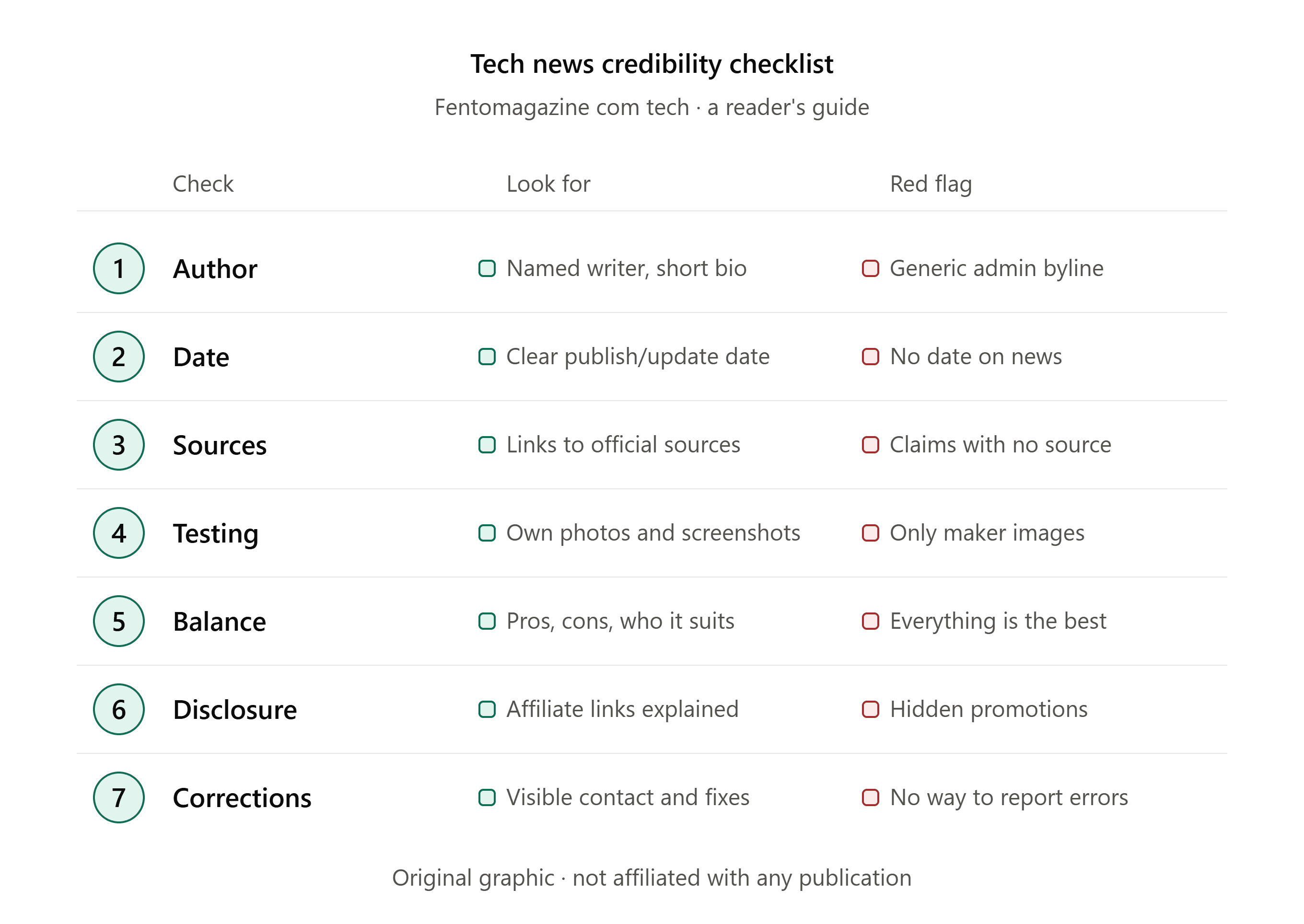
The 7-Point Credibility Checklist for Any Tech Site
Run any tech article, including ours, through this quick test.
| Check | What to look for | Red flag |
|---|---|---|
| 1. Author | A named writer with a short bio | No author, or a generic “admin” byline |
| 2. Date | A clear publish and update date | No date, or a very old date on “latest” news |
| 3. Sources | Links to official announcements, studies or documentation | Claims with no source at all |
| 4. First-hand testing | Original photos, screenshots, measurements | Only manufacturer images and spec sheets |
| 5. Balance | Pros, cons and who the product is not for | Every product is “the best” |
| 6. Disclosure | Honest note about affiliate links or sponsorships | Hidden promotions presented as reviews |
| 7. Correction policy | Visible way to report errors | No contact info, no corrections ever |
You don’t need all seven on every article. But if a site fails four or five, treat it as entertainment, not as a source for decisions.
The Hype Decoder: What Tech Headlines Really Mean
Tech writing loves dramatic language. Here’s how to translate it.
| Headline phrase | What to check |
|---|---|
| “Revolutionary” or “game-changing” | Is there independent testing, or the company’s own claims? |
| “Leaked” or “rumored” | Treat it as unconfirmed until the company or a reliable outlet confirms it |
| “Will replace" | Predictions are opinions, so look for evidence and real adoption numbers |
| “Up to 10x faster” | “Up to” often means a best-case lab result, so check typical performance |
| “AI-powered” | Ask what the AI actually does and whether the feature works without it |
| “Free” | Free to try, free with ads, or paid with your data? Read the terms |
| “Hackers can steal everything” | Look for whether the risk is real, who is affected, and whether a fix exists |
A good habit: whenever a headline excites or scares you, wait ten minutes and look for a second source before you share or act on it.
Five Tech Topics Worth Following (and How to Read Them)
1. AI tools
AI assistants and generators are now part of everyday work, which makes careful use essential. A few safe habits:
- Treat AI output as a first draft, not a final answer.
- Double-check facts, numbers and quotes before you rely on them.
- Avoid pasting passwords, private documents or customer data into tools you haven’t vetted.
- Read the privacy settings to see whether your inputs may be stored or used to improve the service.
2. Cybersecurity and privacy
This is the area where good tech coverage helps most, because the advice is practical. The essentials rarely change:
- Turn on two-factor authentication for email, banking and social accounts.
- Use a password manager or passkeys instead of reusing passwords.
- Install updates on your phone, laptop and apps, since many updates fix security holes.
- Be suspicious of urgent messages asking you to click, pay or log in, which is the classic phishing pattern.
- Back up important files in more than place.
3. Gadgets and buying decisions
Reviews are helpful, but they work best when you match them to your own needs. Before buying:
- Write down your top three must-haves and your budget.
- Compare at least two independent reviews.
- Check the return policy and warranty.
- Look at how long the manufacturer promises software updates.
- Remember that last year’s model is often the best value.
4. Apps and subscriptions
Many people pay for apps they’ve forgotten. a quarter, list your subscriptions, cancel what you haven’t used in a month, and check app permissions for location, microphone and contacts.
5. Tech careers and skills
Whether you’re curious about coding, data, design or support work, free tutorials and beginner courses make it easier than ever to start. Pick small project, finish it, and share it. That beats collecting ten half-finished courses.
A 20-Minute Weekly Tech Routine
You don’t need to read everything. Try this a week:
- 5 minutes: scan headlines from two or three sources you’ve vetted using the checklist above.
- 5 minutes: security check. Install pending updates, and review account’s security settings.
- 5 minutes: learn thing. Read a short explainer or watch tutorial on a tool you actually use.
- 5 minutes: tidy up. Delete unused apps, clear downloads, or cancel subscription.
Twenty focused minutes beat an hour of doomscrolling.
How to Spot Low-Quality or Spammy Tech Content
Search results are full of near-identical articles. These patterns suggest a page was made for search engines, not readers:
- The same phrases repeated over and over, especially the keyword
- Lots of “what is X” paragraphs that never answer anything specific
- No author, no date and no sources
- Generic claims such as “trusted by millions” with no proof
- Pages that promise “complete guides” but contain little original information
If you publish tech content yourself, avoid those habits. Add original screenshots, real testing notes, honest limitations and a named author. Those details are what make a page genuinely useful, and they’re what search engines increasingly reward.
Common Mistakes Tech Readers Make
- Trusting the first search result. Position isn’t proof of accuracy.
- Sharing before checking. Dramatic posts spread faster than corrections.
- Chasing every new gadget. Upgrade when your current device stops meeting your needs, not when a new launches.
- Ignoring updates. Skipping them leaves known weaknesses open.
- Using password everywhere. leak can expose every account.
Frequently Asked Questions
What is fentomagazine com tech?
It’s a phrase people use when looking for the technology content on FentoMagazine.com, a digital publication whose coverage has expanded beyond its social-media roots.
Does Fento Magazine have a separate USA edition?
Public overviews say the main site is FentoMagazine.com and no separate American edition is clearly identified.
How can I tell whether a tech website is trustworthy?
Use the seven-point checklist above: named authors, clear dates, linked sources, first-hand testing, balanced reviews, disclosure and corrections.
Should I trust “leaked” tech news?
Treat leaks as unconfirmed until the company or multiple reliable outlets confirm them.
How often should I update my devices?
Install security updates as soon as they’re available, and enable automatic updates where you can.
Is AI-generated content always bad?
No, but quality varies. What matters is accuracy, originality and usefulness, whether a human or a tool drafted the first version.
Final Thoughts
Whether you’re exploring fentomagazine com tech or any other tech section, the habits that protect you are the same: check who wrote it, when it was written, and what it’s based on. Read with a little healthy skepticism, protect your accounts with the basics, and build a small weekly routine rather than trying to follow everything.
Technology will keep changing. A reliable way of reading about it won’t need to.
Disclaimer: This article is for general information only. Details about third-party websites come from public overviews and may change. Always verify important claims, especially on security, finance or health topics, with official sources.