
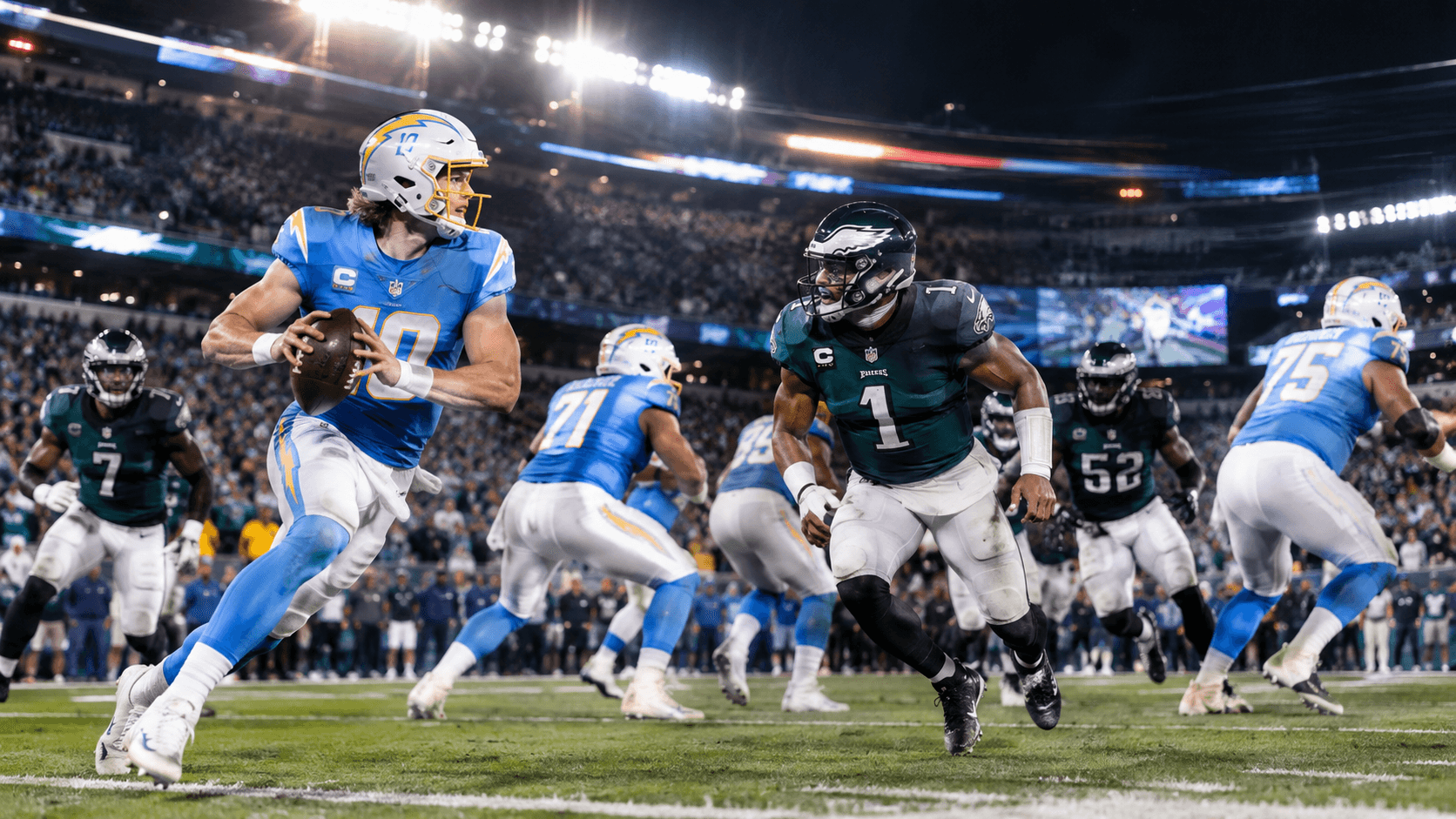
Chargers vs Philadelphia Eagles Match Player Stats: Full Box Score and Game Recap
The Chargers vs Philadelphia Eagles match player stats tell the story of a dramatic NFL contest decided in overtime. The Los Angeles Chargers defeated the Philadelphia Eagles 22–19 on December 8, 2025, after a game filled with defensive pressure, turnovers, big rushing plays, and a tense finish.
Although Philadelphia running back Saquon Barkley produced an impressive performance on the ground, the Chargers took advantage of critical mistakes and made the decisive defensive play in overtime. Justin Herbert contributed as a passer and runner, while the Los Angeles defense played a major role in securing the victory.
This article covers the final score, quarterback statistics, rushing and receiving numbers, important plays, and the key factors that decided the game.
Chargers vs Eagles Match Overview
The Chargers hosted the Eagles at SoFi Stadium in a Week 14 matchup. Philadelphia entered the game looking to establish its offense, while Los Angeles aimed to use its defense and ground game to control the contest.
| Match detail | Result |
|---|---|
| Matchup | Los Angeles Chargers vs Philadelphia Eagles |
| Date | December 8, 2025 |
| Competition | NFL regular season, Week 14 |
| Venue | SoFi Stadium |
| Final score | Chargers 22, Eagles 19 |
| Result | Chargers won in overtime |
The final score does not fully reflect how unpredictable the game became. Both teams had opportunities to take control, but turnovers and defensive stops repeatedly changed the momentum. Los Angeles ultimately came away with the win after forcing another interception during Philadelphia's final overtime possession.
Chargers vs Philadelphia Eagles Final Score by Quarter
The game remained close throughout regulation, with neither team establishing a comfortable lead.
| Quarter | Philadelphia Eagles | Los Angeles Chargers |
|---|---|---|
| First quarter | 3 | 7 |
| Second quarter | 3 | 3 |
| Third quarter | 3 | 3 |
| Fourth quarter | 10 | 6 |
| Overtime | 0 | 3 |
| Final score | 19 | 22 |
The Eagles scored 10 points in the fourth quarter to remain in contention, but the Chargers survived the late pressure. Los Angeles then scored the decisive three points in overtime to complete the 22–19 victory.
Quarterback Stats: Jalen Hurts vs Justin Herbert
Quarterback performance was of the most important parts of this matchup. Both Jalen Hurts and Justin Herbert faced significant defensive pressure, but their performances differed in key moments.
Jalen Hurts Player Stats
| Statistic | Jalen Hurts |
|---|---|
| Completions/Attempts | 21/40 |
| Passing yards | 240 |
| Passing touchdowns | 0 |
| Interceptions thrown | 4 |
| Rushing attempts | 4 |
| Rushing yards | 8 |
Hurts completed 21 of his 40 pass attempts for 240 yards. However, he did not throw a passing touchdown and finished with four interceptions. Those turnovers repeatedly gave Los Angeles opportunities to stop Philadelphia's drives and shift momentum.
The Eagles quarterback also contributed eight rushing yards on four attempts. While Hurts can create plays with his legs, the Chargers limited his rushing production and applied pressure that made passing situations difficult.
His performance illustrates how a quarterback's total yardage can be overshadowed by turnovers. Philadelphia remained competitive, but the interceptions became a major obstacle to building a consistent offensive rhythm.
Justin Herbert Player Stats
| Statistic | Justin Herbert |
|---|---|
| Completions/Attempts | 12/26 |
| Passing yards | 139 |
| Passing touchdowns | 1 |
| Interceptions thrown | 1 |
| Rushing attempts | 10 |
| Rushing yards | 66 |
Herbert completed 12 of 26 passes for 139 yards, with touchdown and interception. His passing numbers were modest, particularly for a quarterback known for his ability to generate yards through the air.
However, Herbert made an important contribution as a runner, gaining 66 yards on 10 attempts. His mobility helped Los Angeles move the ball when its passing game struggled against Philadelphia's pass rush.
Herbert also played through a significant hand injury, making his ability to remain on the field an important part of the story. The Chargers did not rely exclusively on his passing production; they combined quarterback mobility, rushing plays, and defensive pressure to find a way to win.
Quarterback comparison: Hurts produced more passing yards, but his four interceptions proved costly. Herbert threw for fewer yards but added 66 rushing yards and avoided the same level of turnover trouble.
Rushing Stats: Saquon Barkley Leads the Ground Game
The rushing matchup was of the clearest individual highlights of the game. Saquon Barkley delivered Philadelphia's most productive ground performance, while Herbert and the Chargers' running backs helped Los Angeles keep its offense moving.
Philadelphia Eagles Rushing Stats
| Player | Carries | Rushing yards | Touchdowns | Longest run |
|---|---|---|---|---|
| Saquon Barkley | 20 | 122 | 1 | 52 yards |
| Jalen Hurts | 4 | 8 | 0 | — |
Barkley rushed 20 times for 122 yards and scored touchdown. His longest run went for 52 yards, giving Philadelphia a major explosive play and showing why he remained a central part of the Eagles' offensive approach.
The long touchdown run was especially significant because it allowed Philadelphia to generate points without depending entirely on Hurts' passing game. Barkley's speed and ability to find space created of the most memorable offensive moments of the contest.
Hurts, meanwhile, gained eight rushing yards on four attempts. Philadelphia's ground game was therefore led primarily by Barkley, whose production kept the Eagles in a position to compete despite their passing-game difficulties.
Los Angeles Chargers Rushing Stats
| Player | Carries | Rushing yards |
|---|---|---|
| Justin Herbert | 10 | 66 |
| Omarion Hampton | 13 | 56 |
| Kimani Vidal | 14 | 44 |
The Chargers used multiple players to generate rushing production. Herbert's 66 yards were an important contribution, particularly when Philadelphia's defensive front put pressure on him.
Omarion Hampton added 56 yards on 13 carries, while Kimani Vidal recorded 44 yards on 14 attempts. Their combined work helped Los Angeles avoid relying entirely on a passing attack that was struggling to produce consistent results.
The Chargers' approach was effective because it gave the offense different ways to advance the ball. Even when passing opportunities were limited, runs from Herbert and the running backs helped maintain possession and create manageable situations.
Receiving Stats: A.J. Brown Leads Philadelphia
Philadelphia had several productive receivers, with A.J. Brown leading the team in receiving yards. Dallas Goedert also contributed significantly, providing Hurts with another option in the passing game.
Philadelphia Eagles Receiving Stats
| Player | Receptions | Receiving yards | Touchdowns |
|---|---|---|---|
| A.J. Brown | 6 | 100 | 0 |
| Dallas Goedert | 8 | 78 | 0 |
| DeVonta Smith | 4 | 37 | 0 |
Brown finished with six catches for 100 yards. Reaching the 100-yard mark demonstrated his ability to generate meaningful production even though Philadelphia did not score a passing touchdown.
Goedert recorded eight receptions for 78 yards, giving him the highest reception total among the listed Eagles players. His involvement helped Philadelphia move the ball through short and intermediate passing plays.
DeVonta Smith added four catches for 37 yards. Although his receiving total was lower than Brown's and Goedert's, he remained another target available to the Eagles' passing offense.
Despite these contributions, Philadelphia could not convert its passing production into a touchdown through the air. The team's turnovers and inability to finish drives made its offensive numbers less effective on the scoreboard.
Los Angeles Chargers Receiving Stats
The Chargers' receiving numbers were more limited, but several players contributed in different ways.
| Player | Receptions | Receiving yards | Touchdowns |
|---|---|---|---|
| Kimani Vidal | 1 | 60 | 0 |
| Keenan Allen | 3 | 22 | 0 |
| Tre Harris | 1 | 18 | 0 |
| Ladd McConkey | 1 | 12 | 0 |
| Omarion Hampton | 2 | 11 | 1 |
| Quentin Johnston | 2 | 8 | 0 |
| Oronde Gadsden | 1 | 7 | 0 |
| Will Dissly | 1 | 1 | 0 |
Kimani Vidal's 60-yard reception stood out because it provided the Chargers with a major gain despite his primary role as a running back. Plays like this helped Los Angeles create opportunities when its conventional passing attack was not especially productive.
Keenan Allen caught three passes for 22 yards, while Tre Harris and Ladd McConkey added 18 and 12 yards, respectively. Omarion Hampton contributed two receptions for 11 yards and a receiving touchdown, providing an important scoring contribution.
The Chargers did not need a huge passing total from Herbert to win. Instead, they combined selected passing plays with quarterback rushing, contributions from their running backs, and a defense that took advantage of Philadelphia's mistakes.
Key Moments That Decided the Game
Several events helped determine the result of the Chargers vs Eagles matchup.
1. Saquon Barkley's 52-Yard Touchdown Run
Barkley's long touchdown run was of Philadelphia's biggest offensive plays. The 52-yard burst showed his ability to turn a routine rushing opportunity into a major scoring threat.
His performance gave the Eagles an important source of production on a night when their passing game struggled to protect the football. Barkley's 122 rushing yards were a major positive for Philadelphia, even though they were not enough to secure the win.
2. Philadelphia's Turnovers
The Eagles' turnovers became of the defining features of the contest. Hurts threw four interceptions, and the game recap reported five turnovers by Hurts overall when the lost fumble is included.
Turnovers are particularly damaging in close games because they end offensive possessions and can hand the opponent additional opportunities. Philadelphia's mistakes made it harder to turn its yardage into a winning score.
The Chargers' defense deserves credit for capitalizing on those opportunities rather than allowing the Eagles to recover easily after each mistake.
3. Herbert's Rushing Contribution
Herbert's 66 rushing yards helped the Chargers compensate for a passing performance that produced 139 yards. His mobility allowed Los Angeles to move the ball even when the pocket became difficult to manage.
His passing touchdown also gave the Chargers a valuable scoring contribution through the air. Although Herbert's completion percentage and passing yardage were below his usual standards, his ability to contribute in multiple ways remained important.
4. Defensive Pressure on Both Quarterbacks
Neither quarterback had an easy evening. Herbert faced sustained pressure from the Eagles' defense, while Hurts struggled to avoid costly mistakes against Los Angeles.
Herbert was sacked seven times, a career-high at the time, according to the game recap. That pressure limited the Chargers' passing efficiency and made their offensive production harder to sustain.
However, Los Angeles found other ways to win, including quarterback rushing and defensive takeaways. The Eagles also struggled to keep their offense clean, which meant neither team could dominate consistently.
5. The Decisive Overtime Interception
The game reached overtime with the score tied at 19. The Chargers eventually secured the victory with a field goal, while the defense sealed the result by intercepting Hurts on Philadelphia's final overtime drive.
That final defensive play reflected the broader pattern of the game. Philadelphia had enough offensive talent to stay close, but its turnovers repeatedly prevented it from taking control at crucial moments.
Why the Chargers Won
The Chargers' victory came from a combination of defensive execution, mobility at quarterback, and their ability to capitalize on Philadelphia's mistakes.
First, Los Angeles forced turnovers at critical times. Four interceptions against a quarterback such as Hurts can be decisive in a close game, especially when the opposing defense continues to apply pressure.
Second, Herbert contributed on the ground. His 66 rushing yards helped compensate for the Chargers' limited passing production and gave the offense another way to advance the ball.
Third, the Chargers remained competitive despite giving up explosive plays. Barkley's 52-yard touchdown run and 122 rushing yards were impressive, but Philadelphia's offensive mistakes repeatedly interrupted its progress.
Finally, Los Angeles made the decisive play in overtime. Winning a close contest often comes down to execution during the final possession, and the Chargers' defense delivered when the game was on the line.
Why the Eagles Lost Despite Barkley's Performance
Barkley was of the strongest individual performers in the game, but football is a team sport, and rushing success alone cannot guarantee a win.
Philadelphia's biggest problem was ball security. Hurts threw four interceptions and also lost a fumble, according to the game recap. Those mistakes made it difficult for the Eagles to build on Barkley's production and convert offensive opportunities into points.
The passing offense also failed to produce a passing touchdown. Brown reached 100 receiving yards and Goedert caught eight passes, but those contributions were not enough to overcome the turnovers.
Philadelphia remained in the contest until overtime, demonstrating that its defense and rushing attack kept it competitive. Nevertheless, the Eagles could not avoid the critical mistake that allowed the Chargers to finish the game with a victory.
Chargers vs Philadelphia Eagles Match Player Stats: Main Takeaways
The December 8, 2025, matchup offered several important takeaways for NFL fans:
Final result: The Los Angeles Chargers defeated the Philadelphia Eagles 22–19 in overtime.
Top Eagles rusher: Saquon Barkley recorded 122 rushing yards and touchdown on 20 carries.
Top Eagles receiver: A.J. Brown finished with six receptions for 100 yards.
Hurts' passing line: Jalen Hurts completed 21 of 40 passes for 240 yards, with no passing touchdowns and four interceptions.
Herbert's contribution: Justin Herbert passed for 139 yards and touchdown while adding 66 rushing yards.
Major Chargers receiving play: Kimani Vidal recorded a 60-yard reception.
Game-deciding factor: Philadelphia's turnovers and the Chargers' overtime defensive stop played major roles in determining the result.
The box score shows why this game was more complicated than a simple comparison of passing yards. Philadelphia produced the stronger passing-yardage total and had an outstanding rushing performance from Barkley, but the Chargers did a better job taking advantage of turnovers when it mattered most.
Frequently Asked Questions
Who won the Chargers vs Philadelphia Eagles game?
The Los Angeles Chargers defeated the Philadelphia Eagles 22–19 in overtime on December 8, 2025.
How many passing yards did Justin Herbert record?
Justin Herbert threw for 139 yards, completing 12 of 26 attempts with touchdown and interception. He also rushed for 66 yards.
How many rushing yards did Saquon Barkley have?
Saquon Barkley recorded 122 rushing yards on 20 carries and scored touchdown. His longest run was 52 yards.
How many interceptions did Jalen Hurts throw?
Hurts threw four interceptions. The game recap also reported a lost fumble, making turnovers a major factor in Philadelphia's defeat.
Who led the Eagles in receiving yards?
A.J. Brown led the Eagles with 100 receiving yards on six catches. Dallas Goedert added 78 yards on eight receptions.
What was the final score by quarter?
Philadelphia scored 3, 3, 3, and 10 points in the first four quarters, while Los Angeles scored 7, 3, 3, and 6. The Chargers then scored three points in overtime to win 22–19.
Final Thoughts
The Chargers vs Philadelphia Eagles match player stats highlight a game in which defensive execution and turnovers mattered more than total yardage. Saquon Barkley's powerful rushing performance and A.J. Brown's receiving production kept Philadelphia competitive, but Jalen Hurts' interceptions repeatedly put the Eagles in difficult situations.
Justin Herbert's passing numbers were modest, yet his rushing contribution and the Chargers' defensive performance helped Los Angeles survive a challenging contest. The overtime interception was the final turning point, allowing the Chargers to secure a 22–19 victory.
For fans reviewing the box score, the biggest lesson is clear: offensive yardage can keep a team in the game, but protecting the football and making decisive plays often determine the final result.
Stats and game details are based on the official game box score and published NFL recap. This article covers the December 8, 2025, matchup, not a future meeting between the teams.